Antenna Handbook: 02/29/20

Halo Antennas

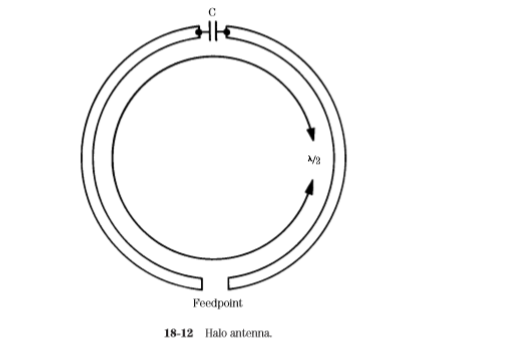
One of the more saintly antennas used on the VHF boards is the halo (Fig. 18-12). This antenna basically takes a half-wavelength dipole and bends it into a circle. 

The ends of the dipole are separated by a capacitor. In some cases, a transmitting-type mica “button” capacitor is used, but in others (and perhaps more commonly), the halo capacitor consists of two 3-in disks separated by a plastic dielectric. 

While air also serves as a good (and perhaps better) dielectric, the use of plastic allows mechanical rigidity to the system.

Groundplane Antennas


The groundplane antenna is a vertical radiator situated above an artificial RF ground consisting of quarter-wavelength radiators. Groundplane antennas can be either 1⁄4-wavelength or 5⁄8-wavelength (although for the latter case impedance matching is needed—see the previous example).

Figure 18-11 shows how to construct an extremely simple groundplane antenna for 2 m and above. The construction is too lightweight for 6-m antennas (in general), because the element lengths on 6-m antennas are long enough to make their weight too great for this type of construction. The base of the antenna is a single SO-239 chassis-type coaxial connector. Be sure to use the type that requires four small machine screws to hold it to the chassis, and not the single-nut variety.

The radiator element is a piece of 3⁄16-in or 4-mm brass tubing. This tubing can be bought at hobby stores that sell airplanes and other models. The sizes quoted just happen to fit over the center pin of an SO-239 with only a slight tap from a lightweight hammer—and I do mean slight tap. If the inside of the tubing and the connector pin are pretinned with solder, then sweat soldering the joint will make a good electrical connection that is resistant to weathering. Cover the joint with clear lacquer spray for added protection.


The radials are also made of tubing. Alternatively, rods can also be used for this purpose. At least four radials are needed for a proper antenna (only one is shown in Fig. 18-11). This number is optimum because they are attached to the SO-239 mounting holes, and there are only four holes. Flatten one end of the radial, and drill a small hole in the center of the flattened area. Mount the radial to the SO-239 using small hardware (4-40, etc.).

The SO-239 can be attached to a metal L bracket. While it is easy to fabricate such a bracket, it is also possible to buy suitable brackets in any well-equipped hardware store. While shopping at one do-it-yourself type of store, I found several reasonable candidate brackets. The bracket is attached to a length of 2 2-in lumber that serves as the mast.

J Pole Antennas

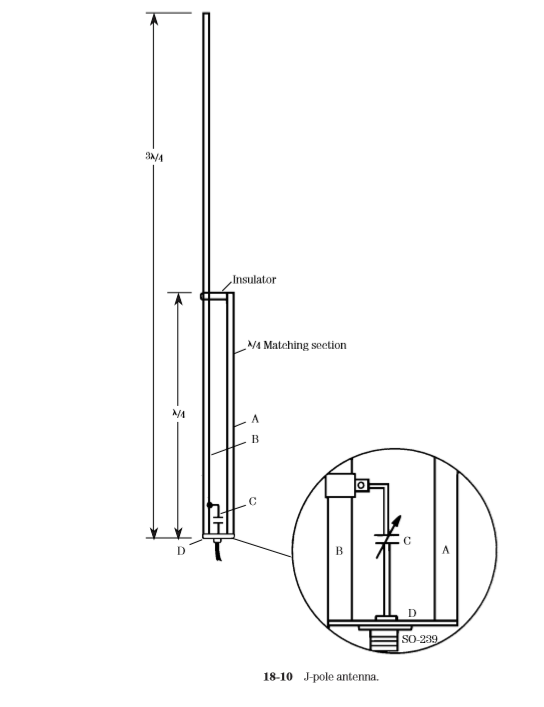
The J-pole antenna is another popular form of vertical on the VHF bands. It can be used at almost any frequency, although the example shown in Fig. 18-10 is for 2 m. The antenna radiator is 3⁄4-wavelength long, so its dimension is found from

Taken together the matching section and the radiator form a parallel transmission line with a characteristic impedance that is 4 times the coaxial cable impedance. If 50-Ω coax is used, and the elements are made from 0.5 in OD pipe, then a spacing of 1.5 in will yield an impedance of about 200 Ω. Impedance matching is accomplished by a gamma match consisting of a 25-pF variable capacitor, connected by a clamp to the radiator, about 6 in (experiment with placement) above the base.

5/8 Wavelength Antenna for 2 m Mobile Radio


The 5⁄8-wavelength antenna (Fig. 18-9) is popular on 2 m for mobile operation because it is easy to construct, and it provides a small amount of gain relative to a dipole. The radiator element is 5⁄8-wavelength, so its physical length is found from:

The 5⁄8-wavelength antenna is not a good match to any of the common forms of coaxial cables. Either a matching section of cable, or an inductor match, is normally used. In Fig. 18-9 an inductor match is used. The matching coil consists of 2 to 3 turns of no. 12 wire, wound over a 1⁄2-in OD form, 1⁄2-in long. The radiator element can be tubing, brazing rod, or a length of heavy “piano wire.” Alternatively, for low-power systems, it can be a telescoping antenna that is bought as a replacement for portable radios or televisions. These antennas have the advantage of being adjustable to resonance without the need for cutting.

Two Meter Yagi Antenna

Figure 18-8 shows the construction details for a six-element 2-meter Yagi beam antenna. This antenna is built using a 2 2-in wooden boom and elements made of either brass or copper rod. Threaded brass rod is particularly useful, but not strictly necessary. 

The job of securing the elements (other than the driven element) is easier when threaded rod is used, because it allows a pair of hex nuts, one on either side of the 2 2-in boom, to be used to secure the element. Nonthreaded elements can be secured with RTV sealing a press-fit. Alternatively, tie wires (see inset to Fig. 18-8) can be used to secure the rods. 

A hole is drilled through the 2 2 to admit the rod or tubing. The element is secured by wrapping a tie wire around the rod on either side of the 2 2, and then soldering it in place. The tie wire is no. 14 to no. 10 solid wire.

Mounting of the antenna is accomplished by using a mast secured to the boom with an appropriate clamp. One alternative is to use an end-flange clamp, such as is sometimes used to support pole lamps, etc. 

The mast should be attached to the boom at the center of gravity, which is also known as the balance point. If you try to balance the antenna in one hand unsupported, there is one (and only one) point at which it is balanced (and won’t fall). Attach the mast hardware at, or near, this point in order to prevent normal gravitational torques from tearing the mounting apart.

The antenna is fed with coaxial cable at the center of the driven element. Ordinarily, either a matching section of coax, or a gamma match, will be needed because the effect of parasitic elements on the driven element feedpoint impedance is to reduce it.
Yagi Antennas

The Yagi beam antenna is a highly directional gain antenna, and is used both in HF and VHF/UHF systems. The antenna is relatively easy to build at VHF/UHF. In fact, it is easier than for HF systems. 

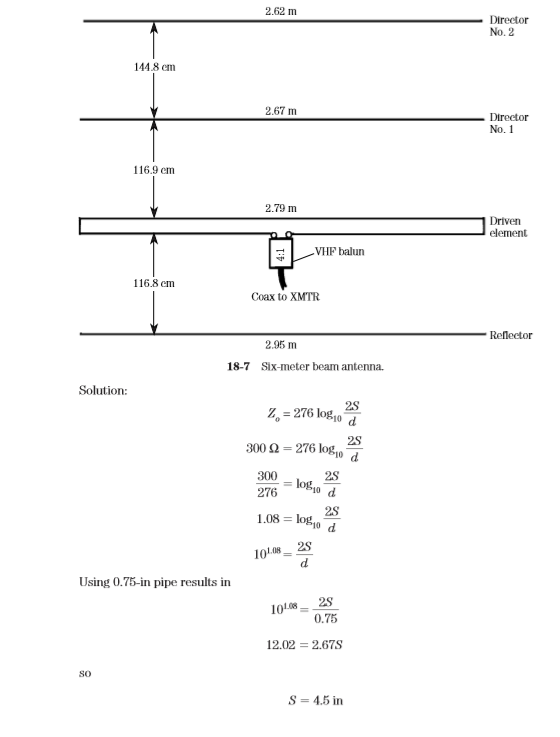
The basic Yagi was covered in Chap. 12, so we will only show examples of practical VHF devices. A 6-m Yagi antenna is shown in Fig. 18-7. This particular antenna is a four-element model. The reflector and directors can be mounted directly to a metallic boom, because they are merely parasitic.

The driven element, however, must be insulated from the metal boom. The driven element shown in Fig. 18-7 is a folded dipole. While this is common practice at VHF, because it tends to broadband the antenna, it is not strictly necessary. 

The dimensions of the driven element are found from Eq. 18.4. Set the equation equal to 300 Ω, select the diameter of the tubing from commercially available sources, and then calculate the spacing.

Example 18-2 Calculate the spacing of a 300-Ω folded dipole when 3⁄4-in tubing is used in its construction.

This Article is from Practical Antenna Handbook by Joseph J. Carr

Collinear Gain Antenna For VHF/UHF Receiver/Transmitter

Gain in antennas is provided by directivity. In other words, by taking the power radiated by the antenna, and projecting it into a limited direction, we obtain the appearance of higher radiated power. In fact, the effective radiated power (ERP) of the antenna is merely its feedpoint power multiplied by its gain. 

Although most antenna patterns are shown in the horizontal dimension (as viewed from above), it is also possible to obtain gain by compressing the vertical aspect. In this manner it is possible to have a vertical antenna that produces gain. Figure 18-6 shows a collinear gain antenna, with vertical polarization and a horizontally omnidirectional pattern. Incidentally, when mounted horizontally the pattern becomes bidirectional.

The collinear antenna shown in Fig. 18-6 is basically a pair of stacked collinear arrays. Each array consists of a quarter-wavelength section A and a half-wavelength section C separated by a quarter-wavelength phase reversing stub B. The phase reversal stub preserves in-phase excitation for the outer element (referenced to the inner element).

The feedpoint is between the two elements of the array (i.e., between the A sections). The coaxial-cable impedance is transformed by a 4:1 balun transformer (see Fig. 18-1A). Alternatively, 300-Ω twin lead can be used for the transmission line. If this alternative is used, then the use of UHF shielded twin lead is highly recommended. If the transmitter lacks the balanced output needed to feed twin lead, then use a balun at the input end of the twin lead (i.e., right at the transmitter).

Coaxial Vertical Antenna For VHF/UHF Receiver/Transmitter

The coaxial vertical is a quarter-wavelength vertically polarized antenna that is popular on VHF/UHF. There are two varieties. In Fig. 18-5A we see the coaxial antenna made with coaxial cable. Although not terribly practical for long-term installation, the coax-coax antenna is very useful for short-term, portable, or emergency applications. 

For example, a boater found himself adrift, and in dire trouble, after a storm damaged the boat. The mast-top VHF antenna was washed away, leaving only the end of the coaxial cable dangling loose. Fortunately, the boat operator was a two-way radio technician, and he knew how to strip back the coaxial cable to make an impromptu coaxial vertical.

The coax-coax antenna shown in Fig. 18-5A uses a quarter-wavelength radiator and a quarter-wavelength sleeve. The sleeve consists of the coax braid stripped back and folded down the length of the coax cable. The maximum length is found from the equation below (actual length is trimmed from this maximum):


The antenna is mounted by suspending it from above by a short piece of string, twine, or fishing line. From a practical point of view, the only problem with this form of antenna is that it tends to deteriorate after a few rainstorms. This effect can be reduced by sealing the end, and the break between the sleeve and the radiator, with either silicone RTV or bathtub caulk. A more permanent method of construction is shown in Fig. 18-5B. The sleeve is a piece of copper or brass tubing (pipe) about 1 in in diameter. An end cap is fitted over the end and sweat-soldered into place. The solder is not intended to add mechanical strength, but rather to prevent weathering from destroying the electrical contact between the two pieces. An SO-239 coaxial connector is mounted on the end cap. The coax is connected to the SO-239 inside the pipe, which means making the connection before mounting the end cap.

The radiator element is a small piece of tubing (or brazing rod) soldered to the center conductor of a PL-259 coaxial connector. An insulator is used to prevent the rod from shorting to the outer shell of the PL-259. (Note: an insulator salvaged from the smaller variety of banana plug can be shaved a small amount with a fine file and made to fit inside the PL-259. It allows enough center clearance for 1⁄8-inch or 3⁄16-inch brass tubing.) Alternatively, the radiator element can be soldered to a banana plug. The normalsize banana plug happens to fit into the female center conductor of the SO-239.