Antenna Handbook: 01/17/22

Radiation pattern with matlab

patternCustom

Plot radiation pattern using spherical coordinate system (phi and theta angles)

Syntax
patternCustom(magE,theta,phi)
patternCustom(magE,theta,phi,Name,Value)
hplot = patternCustom(___)

Description
patternCustom(magE,theta,phi) plots the 3-D radiation pattern of an antenna magnitude, magE over the specified phi and theta angle vectors.

hplot = patternCustom(___) returns handles of the lines or surface in the figure window. This syntax accepts any combination of arguments from the previous syntaxes

Examples

Visualize Radiation Pattern From Antenna Data File
Consider a helix antenna data file in .csv format. This file contains the magnitude of the antenna directivity in phi and theta angles. Read The File 
Command : openExample('antenna/VisualizeRadiationPatternFromAntennaDataFileExample')

helixdata = csvread('antennadata_test.csv',1,0);

Use patternCustom to extract the magnitude of directivity, and the phi, and theta angle values. Plot the 3-D polar radiation pattern.

patternCustom(helixdata(:,3),helixdata(:,2),helixdata(:,1));
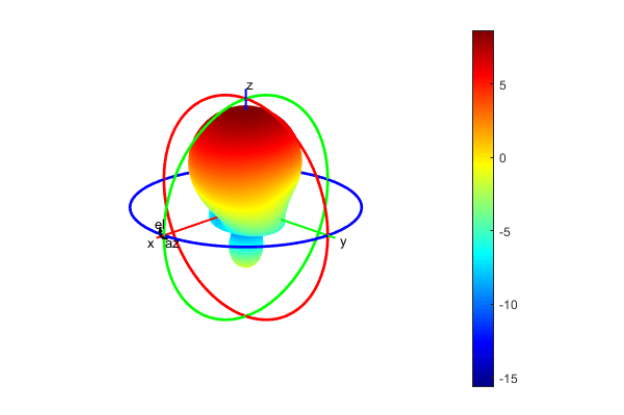
Visualize Radiation Pattern From Antenna Data File

Visualize Radiation Pattern From Antenna Data File


Use the same data to plot the 3-D rectangular radiation pattern.


figure
patternCustom(helixdata(:,3),helixdata(:,2),helixdata(:,1),...
 'CoordinateSystem','rectangular');
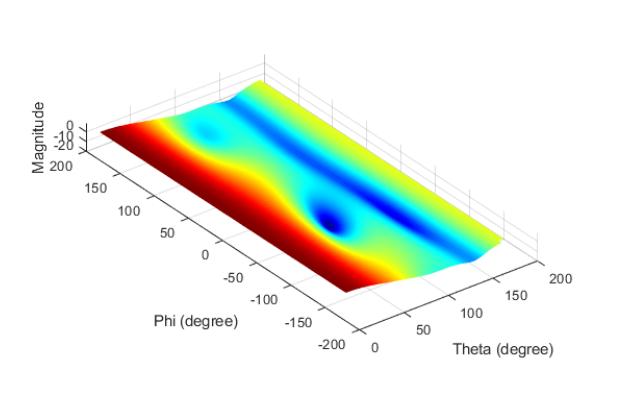
3D Rectangular radiation Pattern


Visualize 2-D Radiation Patterns of Helix Directivity


Calculate the magnitude, azimuth, and elevation angles of a helix's directivity at 2 GHz.

Command :

openExample('antenna/VisualizeRectangularAndPolar2DRadiationPatternOfHelixExample')

h = helix;
[D,az,el] = pattern(h,2e9);

Here, az = the angle from the positive x-axis to the directivity vector's orthogonal projection onto the xy plane, moving in the direction towards the y-axis.

el = the angle from the directivity vector's orthogonal projection onto the xy plane to the vector, moving in the direction towards the z-axis.

Extract theta and phi angles of the directivity magnitude.

phi = az';
theta = (90-el);
MagE = D';

Plot 2-D phi slice of the antenna in rectangular coordinates.

figure;
patternCustom(MagE,theta,phi,'CoordinateSystem','rectangular',...
    'Slice','phi','SliceValue',0);

Plot 2-D phi slice of the antenna in rectangular coordinates.


Plot 2-D phi slice of the antenna in polar coordinates.


figure;
patternCustom(MagE, theta, phi,'CoordinateSystem','polar',...
    'Slice','phi','SliceValue',0);
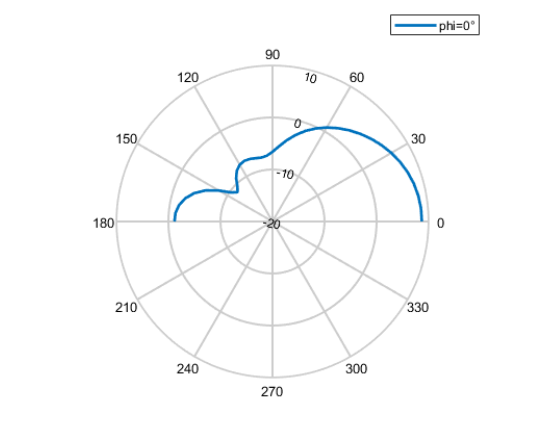
Plot 2-D phi slice of the antenna in polar coordinates
Plot 2-D phi slice of the antenna in polar coordinates.


rf bnc 50 ohm attenuator

rf bnc 50 ohm attenuator


rf bnc 50 ohm attenuator

Attenuators - Interconnects PADS BNC 50 OHM BNC(M) (F) 20db - 

Is 20db enough attenuation to reduce 1W output to 0.5W ? 
20dB for this attenuator provides drop of voltage 10 times into 50 Ohms load. The power which is V^2/R will drop 100 times accordingly . The difference between 1 watt and 0.5 watts is 3 db. A 20 db attenuation is 1/100. 1 watt input gives 0.01 watt output. It will reduce your 1 Watt to .01 Watt. If you really need 0.5 Watt , then you need a 3 DB attenuator. It goes loke this: 3 db = half the power; 6 db = one fourth the power; 9 db = one eighth of the power; 10 db = one tenth of the power; 20 db = one one-hundreth of the power.  Said another way: for every 3 db of attenuation reduce the power by one-half. For every 10 db reduce the power by a factor of ten A 3db drop is half power.

What's the working frequency range of this attenuator? I need one working between 0.5 and 3 MHz with minimal distortion of the waveform.
I use them on 490MHz all the way to 875MHz, don't see distortion on waveform but I mainly use them to drop the signal so I don't overload enritsu or pathtrax. 

What is the maximum power input in Watts for this attenuator?
Max power input isn't indicated on the attenuator itself, but I've been running 1/2W through it without any problems so far.

will this attenuator work @ 30mhz and below ? I want to attenuate the input on a spectrum analyzer for use on the HF bands
You are looking at a resistive Attenuator. Should work all the way down to DC as long as you keep the power level low. At the upper frequency range you are limited by the BNC connection but should be good to 1GHZ.