Antenna Handbook

Wire Direction Antenna

A directional antenna has the ability to enhance reception of desired signals, while rejecting undesired signals arriving from slightly different directions. Although directivity normally means a beam antenna, or at least a rotatable dipole, there are certain types of antenna that allow fixed antennas to be both directive and variable.


See Chap. 7 for fixed but variable directional antennas and Chap. 11 for fixed and non-variable directive arrays. Those antennas are transmitting antennas, but they work equally well for reception. This section shows a crude, but often effective, directional antenna that allows one to select the direction of reception with pin plugs or switches.

Consider Fig. 13-10. In this case, a number of quarter-wavelength radiators are fanned out from a common feedpoint at various angles from the building. 

At the near end of each element is a female banana jack. A pair of balanced feedlines from the receiver (300-Ω twin lead, or similar) are brought to the area where the antenna elements terminate. 

Each wire in the twin lead has a banana plug attached. By selecting which banana jack is plugged into which banana plug, you can select the directional pattern of the antenna. If the receiver is equipped with a balanced antenna input, then simply connect the other end of the twin lead direction to the receiver. 

Otherwise, use one of the couplers shown in Fig. 13-11. Figure 13-11A shows a balanced antenna coupler that is tuned to the frequency of reception. 

The coil is tuned to resonance by the interaction of the inductor and the capacitor. Antenna impedance is matched by selecting the taps on the inductor to which the feedline is attached. A simple RF broadband coupler is shown in Fig. 13-11B. 

This transformer is wound over a ferrite core, and consists of 12 to 24 turns of no. 26 enameled wire, with more turns being used for lower frequencies, and fewer for higher frequencies. Experiment with the number of turns in order to determine the correct value. 

Alternatively, use a 1:1 balun transformer instead of Fig. 13-11B; the type intended for amateur radio antennas is overkill powerwise, but it will work nicely.


Field Strength Meter Circuit Diagram For CB Radio 27 MHz SSB

This meter can often help you get better signal transfer between antenna and transceiver than an SWR meter. 
 

The Circuit 

You can make your own field strength meter for just a few dollars by following this circuit diagram. Wiring is not critical , but use metal housing.


Buil This High Gain Rhombic TV Antenna

This Rhombic Antenna was from Popular Electronics Magazine October 1975 Edition. Cheap cost Antenna , and if your roof house non metallic can match with contour house. Easy to build and Install , provides good reception , almost 14 dB gain. It can be installed without support masts. High gain, broad bandwidth and good directionallity are characteristic of the rhombic's performance.

Rhombic Antenna Design 

 The first step in designing the rhombic is to decide what channels you want to recieve.

The relative location of their transmitting antennas with respect to your home. And the physical layout of the installation site ( we assume the antenna is mounted horizontally on the pitched roof of wood house) , for modern today house we should move antenna to outside of roof, because today house construction using steel frame.

For optimum result three basic designs are given, covering VHF Lo, VHF Hi, and UHF Bands. The VHF Lo Antenna measures 25 Feet ( 7.6 m) on a side and cover channels 2 through 6 and the FM Broadcast Bands.
The VHF Hi design , spanning channels 7 through 13, has legs one-third the length of those for VHF Lo.


Our TV Antenna Type and Specification List we can offer

TV Antenna 
Type : YNX-HD-T-C01


Specification 


Minimal Quote : 100 pcs , maximum Quote : 5000 pcs


TV Antenna 
Type : YNX-HD-T-C02

Specification :


Minimal Quote : 100 pcs , maximum Quote : 5000 pcs


Type TV Antenna
YNX-HD-T-C03


Specification
Minimal Quote : 100 pcs , maximum Quote : 5000 pcs


Type TV Antenna
YNX-HD-T-C04

Specification
Minimal Quote : 100 pcs , maximum Quote : 5000 pcs


Type TV Antenna

YNX-HD-T-C05


Specification


Minimal Quote : 100 pcs , maximum Quote : 5000 pcs


Build The Microcomputer SAP-1 (Continues 1)

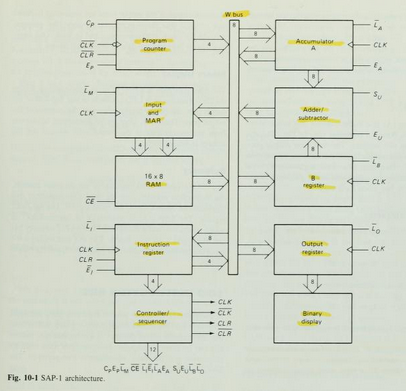
As described in article before about the architecture of Microcomputer SAP-1 , in this article we will continue with other part of Microcomputer Diagram Block and circuit .
For you reference , in figure 10-1 as described  have Instruction Register, Accumulator, B Register, Output Register, and Binary Display, We will describe all about it in this article.


Instruction Register

The Instruction register is part of the control unit. to fetch an instruction from the memory the computer does a memory read operation. 

This places the contents of the addressed memory location on the W bus . At the same time, the instruction register is set up for loading on the next positive clock edge.

The contents of the instruction register are split into two nibbles. The upper nibble is a two-state output that goes directly to the block labeled "Controller sequencer". The lowe nibble is a three-state output that is read onto the W bus when needed.

Controller-Sequencer

The lower left block contains the controller-sequencer. Before each computer run, a Low CLR signal is sent to the program counter and a CLR signal to the instruction register.