Antenna Handbook

Mastering Resistor Color Code Calculator and Chart—4 Band, 5 Band, or 6 Band Resistors

In the intricate world of electronics, resistors play a pivotal role, regulating current flow and shaping circuits. Understanding their values is paramount, and the resistor color code system simplifies this task. Whether you're a seasoned engineer or an enthusiastic hobbyist, mastering resistor color codes is essential. This comprehensive guide delves into the intricacies of resistor color codes, accompanied by handy calculators and charts to decipher them effortlessly.


Understanding Resistor Color Code:

Resistor color coding is a standardized method employed to denote the resistance value, tolerance, and sometimes reliability or temperature coefficient of resistors. This system assigns colors to digits and multipliers, which when decoded, reveal the resistance value in ohms. Additionally, color bands indicate tolerance levels, allowing for precise circuit design and troubleshooting.

The Basic Color Code System:

Traditionally, resistors feature four color bands, with each representing a specific digit or multiplier. The first two bands signify significant digits, the third represents the multiplier, and the fourth indicates tolerance. For instance, a resistor with color bands red, red, orange, and gold corresponds to a resistance value of 22 kΩ with a tolerance of ±5%.

Expanding to Five and Six Band Resistors:

To accommodate a wider range of values and tighter tolerances, five and six band resistor color coding systems were introduced. Five-band resistors add an additional significant digit, while six-band resistors include two additional significant digits. These enhancements enable precise resistance determination for specialized applications.

Utilizing Resistor Color Code Calculators:

While decoding resistor color bands manually is feasible, it's time-consuming and prone to errors. Enter resistor color code calculators—a boon for engineers and hobbyists alike. These online tools swiftly analyze color bands, providing accurate resistance values and tolerances within seconds. Let's take a look at an example:

Example of Resistor Color Code Calculator:

Imagine you have a resistor with color bands: yellow, violet, red, gold. Using a resistor color code calculator, input these colors, and voilà! The calculator swiftly reveals the resistor's resistance value as 47 kΩ with a tolerance of ±5%. This illustrates the efficiency and convenience offered by these calculators.

Resistor Color Code Chart:

In addition to calculators, reference charts are invaluable resources for decoding resistor color bands. These charts categorize color codes based on their corresponding values, facilitating quick identification and analysis. Below is a simplified version of a resistor color code chart:

courtesy Arrow.com


Three or four band resistors

The first two bands always denote the first two digits of the resistance value in ohms. On a three or four-band resistor, the third band represents the multiplier. 
This multiplier will basically shift your decimal place around to change your value from mega ohms to milliohms and anywhere in between. The fourth color band
 signifies tolerance. Keep in mind that if this band is absent and you are looking at a three-band resistor, the default tolerance is ±20%.

Five or six band resistors

Resistors with high precision have an extra color band to indicate a third significant digit. If your resistor has five or six color bands, the third band becomes this
 additional digit along with bands one and two. Everything else shifts to the right, making the fourth color band the multiplier and the fifth band the tolerance. 

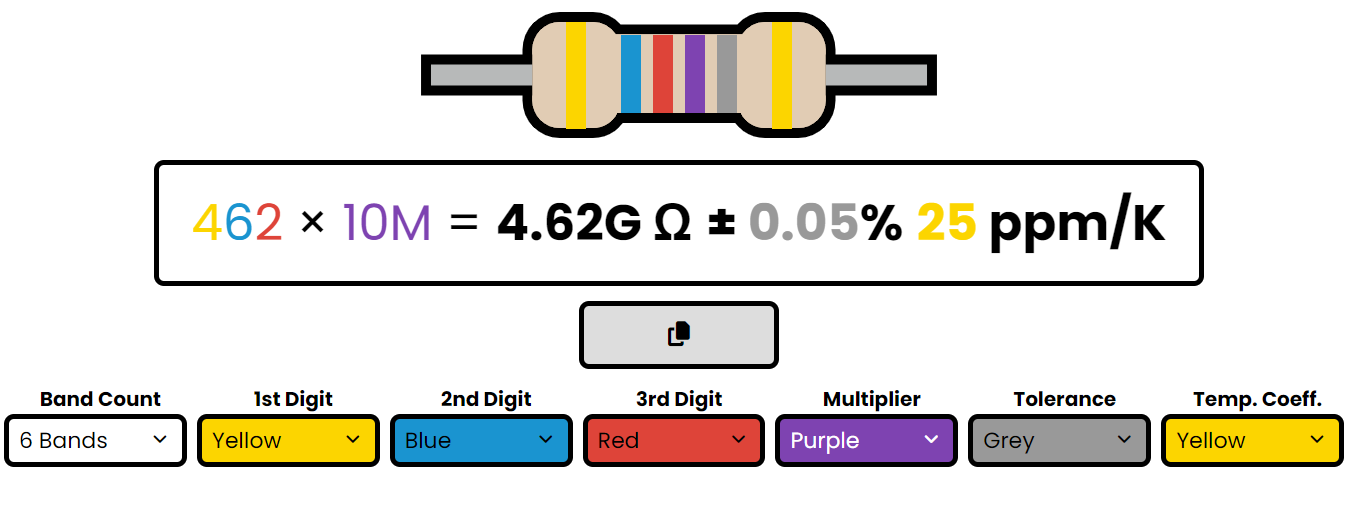
A six-band resistor is basically a five-band type with an additional ring indicating the reliability, or the temperature coefficient (ppm/K) specification. 

Using brown, the most common sixth band color, as an example, every temperature change of 10°C changes the resistance value by 0.1%.

This Link Lists from Github will bring you to Resistor Color Code Calculator, you can choose for 3 Bands, 4 Bands, 5 Bands, 6 Bands

A tiny web app made in Svelte and Vite that decodes your resistors.
3 Bands Resistor Color Code Calculator


4 Bands Resistor Color Code Calculator 


5 Bands Resistor Color Code Calculator 


6 Bands Resistor Color Code Calculator 


2.  resistor-calculator color code 
Web app that calculates the resistance provided by a resistor based on the coloured 4 until 6 bands on the resistor body.
Go here to try it out.

4 Bands Resistor Color Code Calculator 


5 Bands Resistor Color Code Calculator 


6 Bands Resistor Color Code Calculator 


Link for Resistor Calculator https://gestalte.github.io/resistor-calculator/


React-based web app that lets you inventory your resistors by reading their color codes. This project is alternative to the classic to-do app . You can see the demo here: https://jhordyess.github.io/resistor-tracker/

Resistor Tracker Color Code Calculator 


    You can see the demo here: https://jhordyess.github.io/resistor-color-code/


Standard Resistors, 1%, 5%, and 10%

Standard resistors are fundamental components in electronic circuits, providing precise resistance values to control the flow of electric current. They are categorized based on their tolerance, which indicates the permissible deviation from their nominal resistance value. Resistors with a tolerance of 1%, 5%, and 10% are commonly used in electronic applications.

1% Tolerance Resistors:
These resistors are highly precise, with a tolerance of ±1% from their specified resistance value. They are suitable for applications where tight accuracy and stability are required, such as in precision instruments, measurement devices, and high-performance electronic circuits. 1% tolerance resistors offer consistent and reliable performance, ensuring minimal deviation from the desired resistance value.

5% Tolerance Resistors:
Resistors with a tolerance of 5% are widely used in general-purpose electronic circuits and consumer electronics. While they offer sufficient accuracy for many applications, they may exhibit slightly larger deviations from their nominal resistance values compared to 1% tolerance resistors. However, they are cost-effective and readily available, making them suitable for a wide range of applications where precision requirements are not critical.

10% Tolerance Resistors:
With a tolerance of ±10%, these resistors have the widest permissible deviation from their nominal resistance values. They are commonly used in low-precision applications, such as voltage dividers, current limiting circuits, and basic electronic projects where precision requirements are relatively lenient. Despite their lower accuracy, 10% tolerance resistors are economical and suitable for hobbyist projects and educational purposes.


Graphical Resistor Calculator (4 Band)

Graphical Resistor Calculator

Graphical Resistor Calculator is a Free Software to easily calculate the resistance of registers from the band colors.

Simply change the values from the dropdown menus.

Band 1Band 2Band 3Band 4
Value 1 (MSV)Value 2WeightTolerance
   

Resistance:  

1,000 Ω ±5%

Graphical Resistor Calculator Reference Chart

Standard Table For Calculating 4 Band Resistors' Resistance.

ColorDigit valueMultiplierMultiplied OutTolerance
Black01001
Brown110110
Red2102100
Orange31031,000
Yellow410410000
Green5105100,000
Blue61061,000,000
Violet710710,000,000
Gray8108100,000,000
White91091,000,000,000
Gold±5%
Silver±10%

Demystifying Coverage: A Guide to T-Mobile Home Internet Availability


In today's hyper-connected world, reliable and high-speed internet access is no longer a privilege; it's a necessity. Fueling our work, entertainment, and communication, a robust internet connection underpins our digital lives. Enter T-Mobile Home Internet, a service promising to revolutionize internet access by leveraging the power of T-Mobile's nationwide 5G network. However, a crucial question arises: "Is T-Mobile Home Internet available in my area?"

This comprehensive guide dives into the world of T-Mobile Home Internet availability, exploring how to check coverage, understanding factors that influence it, and analyzing the pros and cons of this innovative service. We'll equip you with the knowledge to determine if T-Mobile Home Internet can be your gateway to a supercharged internet experience.

Understanding T-Mobile Home Internet Availability

T-Mobile Home Internet leverages the reach of T-Mobile's 5G network to deliver high-speed internet access directly to your home. Unlike traditional cable or fiber optic internet that relies on physical cables, T-Mobile Home Internet utilizes cellular technology, potentially offering a faster and more convenient setup process. However, unlike these established options, T-Mobile Home Internet availability can vary significantly depending on location. (keyword: T-Mobile Home Internet availability)

How to Check T-Mobile Home Internet Availability?

The first step to unlocking the potential of T-Mobile Home Internet is to verify if it's available in your area. Here's how:

  • T-Mobile Website: Visit the T-Mobile website and navigate to the "Home Internet" section. Look for a "Check Availability" option, typically requiring you to enter your address. The website will then display if T-Mobile Home Internet service is available at your location. (keyword: T-Mobile Home Internet check availability)
  • T-Mobile App: The T-Mobile app also offers an "Availability Check" feature. Download the app and follow the prompts to enter your address and see if T-Mobile Home Internet is available in your area.

Factors Affecting T-Mobile Home Internet Availability

Several factors can influence T-Mobile Home Internet availability in your area:

  • 5G Network Coverage: T-Mobile Home Internet relies on the existing 5G network infrastructure. Areas with strong 5G coverage are more likely to have T-Mobile Home Internet availability compared to rural or remote locations. (keyword: T-Mobile Home Internet 5G coverage)
  • Network Congestion: Cellular networks like T-Mobile's 5G network can experience congestion during peak usage times. This can potentially impact T-Mobile Home Internet availability and performance in densely populated areas.
  • Line of Sight: Cellular signals can be affected by physical barriers like buildings or trees. In some cases, your home's location and surrounding environment might impact the availability and strength of the signal for T-Mobile Home Internet.

Example of T-Mobile Home Internet Availability

Imagine a bustling city with a well-developed T-Mobile 5G network infrastructure. Residents in this city are more likely to have T-Mobile Home Internet availability compared to a small, remote town with limited 5G coverage.

T-Mobile Home Internet Availability: Services and Products

While T-Mobile Home Internet availability can vary by location, the service itself offers a straightforward set of options:

  • T-Mobile Home Internet: This base plan provides access to T-Mobile's 5G network for your home internet needs.
  • T-Mobile Home Internet Plus: This premium plan includes all the benefits of the base plan, along with a whole-home mesh Wi-Fi system to extend coverage throughout your home and eliminate dead zones. (keyword: T-Mobile Home Internet plans)

Pros and Cons of T-Mobile Home Internet Availability

T-Mobile Home Internet availability offers both advantages and potential drawbacks:

Pros:

  • Broader Coverage Potential: T-Mobile's extensive 5G network offers the potential for T-Mobile Home Internet availability in areas not serviced by traditional cable or fiber optic providers. (keyword: T-Mobile Home Internet broader coverage)
  • Faster Speeds: Depending on your location and network congestion, T-Mobile Home Internet can potentially offer significantly faster download and upload speeds compared to traditional DSL or cable connections. (keyword: T-Mobile Home Internet faster speeds)
  • Easy Setup: The T-Mobile Home Internet gateway is self-installable, eliminating the need for technician visits and long wait times.
  • No Contracts: Unlike some traditional ISPs, T-Mobile Home Internet doesn't lock you into long-term contracts, offering flexibility for your needs.

Cons:

  • Limited Availability: 5G network coverage and speeds can vary significantly depending on location. Rural areas or locations with limited 5G infrastructure might experience slower speeds or limited availability compared to urban areas. (keyword: T-Mobile Home Internet limited availability)
  • Data Caps (Potential): While not a hard data cap, T-Mobile prioritizes internet traffic for users with lower data usage during times of network congestion. High data users might experience slower speeds during peak usage times. (keyword: T-Mobile Home Internet data caps)
  • Network Congestion: Cellular networks are inherently more susceptible to external factors like weather or network congestion, potentially impacting reliability compared to wired connections. In areas with high user density, congestion can significantly impact T-Mobile Home Internet performance. (keyword: T-Mobile Home Internet network congestion)
  • Limited Customer Service Options: Compared to traditional ISPs, T-Mobile's customer service options might be more limited, particularly for in-person support. This could be a concern for users who require more hands-on troubleshooting assistance.

Benefits and Advantages of T-Mobile Home Internet Availability

Despite the potential drawbacks, T-Mobile Home Internet availability offers compelling advantages for those in serviced areas:

  • Improved Online Gaming: Faster speeds and lower latency can significantly enhance online gaming experiences with smoother gameplay and reduced lag. (keyword: T-Mobile Home Internet online gaming)
  • Seamless Streaming: Enjoy high-definition streaming of movies, TV shows, and music without buffering or lag, allowing you to fully immerse yourself in your favorite content. (keyword: T-Mobile Home Internet streaming)
  • Faster Downloads and Uploads: Download large files, software updates, and games in a fraction of the time compared to slower internet connections, boosting your overall productivity and efficiency. (keyword: T-Mobile Home Internet download speed)
  • Enhanced Video Conferencing: Experience clear and uninterrupted video calls for work, school, or staying connected with loved ones, ensuring a smooth and reliable communication experience. (keyword: T-Mobile Home Internet video conferencing)
  • Flexibility: No long-term contracts allow you to adapt your internet plan based on your changing needs, offering greater flexibility compared to traditional ISP contracts.

The Future of T-Mobile Home Internet Availability

T-Mobile is continuously expanding its 5G network infrastructure, aiming to bring T-Mobile Home Internet availability to more locations. As the 5G network grows, so does the potential for wider T-Mobile Home Internet coverage. Additionally, advancements in technology like beamforming and network optimization can potentially improve signal strength and mitigate the impact of congestion in certain areas.

Conclusion

T-Mobile Home Internet availability offers a promising alternative for internet access, particularly in areas not well-served by traditional options. However, it's crucial to consider your location, internet usage habits, and tolerance for potential fluctuations in speed and availability before making a decision. By carefully evaluating the pros and cons, and checking availability in your area, you can determine if T-Mobile Home Internet can be the key to unlocking a supercharged internet experience for your home.