Antenna Handbook | Best Antennas, Free Calculators & Top Antenna Deals: 2011

Electrochemical Liquid Vortexing Ionization System

This article is nothing to do with antenna system, but because I like to share everything what have been my interest. I will shared to everybody. This article is proved experiment from it's original at http://www.the-elvis.info , Kaialoha foundation, implement and tested cheap device that saving your fuel with low cost and reduce the CO emission to the air.


The writer pleased everybody to share his knowledge, you can copied this article and write it,make it,commercial it,all he ask you only tell his website on your page, like I do.

It is very simple device, all you need is a copper wire, aluminium wire or aluminium from coke,zinc or stainless steel wire,plastic inline fuel filter, and aluminium or stainless steel mesh and neodymium rare earth magnet ( more powerful than ordinary magnet, you can find it from old hard drive or you can experiment with magnet from old speaker).


How to make the recipe ?

Mixed 1/2 teaspoon of copper wire, aluminium wire,and zinc galvanized or stainless steel and break up the neodymium magnet mixed it.
You can find copper wire from old transformator,or old electric motor, and for aluminium you can use from coke can, for stainless steel you can use from coin or spoon or you can buy stainless steel wire,and neodymium magnet you can find it from old hard drive.
This is only my suggestion,maybe you have better ideas for find the ingredients for this project.

My Ilustration of this device :


The Installation :

  On his experiment,this device proved can reduce or saving the use of gasoline or diesel,and also reduce the CO Emission to the air. Last, I will post my experiment with this device on my diesel car to you.

E.L.V.I.S. recipe
How to make your own E.L.V.I.S.
Personal model.

Ingredients:

Copper shot
Aluminum shot
Zinc or Stainless steel shot
Ordinary plastic inline fuel filter
small piece of aluminum or stainless steel mesh

Optional

fancy metal screw type cleanable fuel filter
small Neodymium (rare earth) magnet
Small pice of aluminum

Recipe

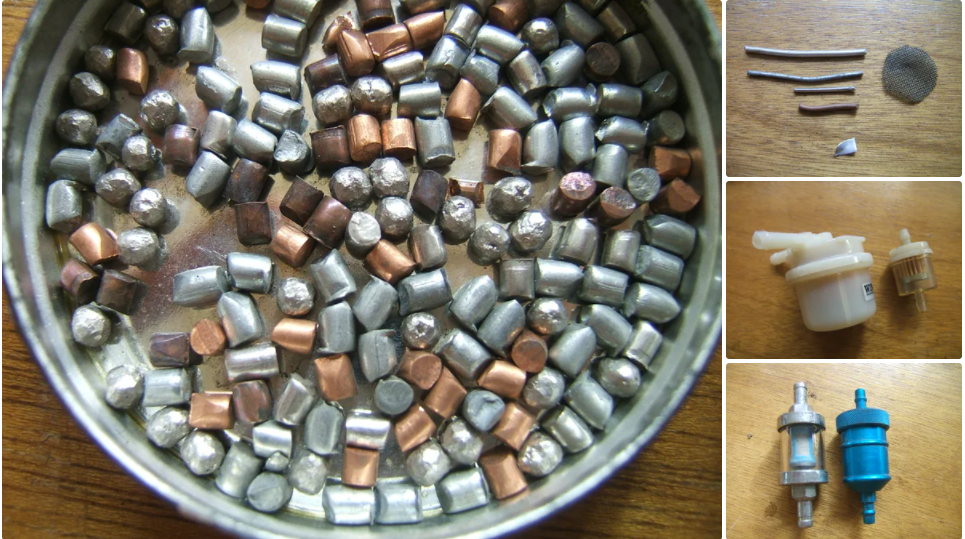
Make 1/2 tsp of copper, aluminum, zinc (or stainless steel) shot by cutting approx.1/8 inch pieces of approx. 1/8 inch thick wire. For zinc use ordinary galvanized chainlink fence type wire.

Buy an ordinary economy plastic fuel filter intended for the engine you have in mind. Or use a more expensive metal screw open replacable/cleanable type.

Insert all the shot one by one into the filter through the intake tube. Tap it all down into the canister.

Optional: Break up a neodymium (rare earth) magnet small enough to insert a small piece in with the beads.

Either of the following

1) Cut a small unpainted piece of aluminum from a beer can to 1/4 inch long and wide as the inside diameter of output tube. make a longitudinal 1/2 twist in it (like a barber pole). Insert tightly into output tube so that no bead can get through. (test this)

2) Cut a 1/4 inch x 1/2 inch approx piece of stainless steel or aluminum mesh with holes smaller than 1/8 inch. Roll or fold it and insert into output tube so as to prevent beads from coming through. Test this.

Installation

Install like an ordinary extra fuel filter observing the direction arrows - input tube toward fuel tank, output tube toward fuel pump/carburetor. Must be located after the normal fuel filter and before the fuel pump/carburetor. Your normal filter now prefilters the fuel prolonging the life of the E.L.V.I.S. by slowing down clog up. Use extra fuel hose as needed but locate E.L.V.I.S. as close to fuel pump/carburetor as possible and stabilize it in some manner in a level position away from heat sources.

E.L.V.I.S. will work forever and never wear out. However. Since the EL Cheapo version above uses a paper element filter, it will eventually clog up even with another filter prefiltering the fuel. This will probably take years (if you change the prefilter at recommended intervals). When it eventually clogs up...well you'll have to pass up another Starbucks latte :-) Those who want to avoid this can use a fancy metal screwtype filter and replace the filter element with the beads. No clogging problem ever.

Commercial model.

Same recipe and ingredients as the personal model but with the following modifications. Big trucks, buses, construction machines usually use a large canister type fuel filter with hydraulic type lines and fittings.

The cheapest method:

Fill the element canister 1/2 to 2/3 with shot/magnet so the reservoir is ionized and then sucked through the filter.

The expensive method:

Install another fuel filter canister made as above. This involves extra lines and fittings that have to be made by qualified hydraulic mechanics. This is not expensive as the components are stock.

Good for all engines, marine/autos/pickups, gas or diesel. Not LPG...

Tested Result :


Original article (sources) : http://www.the-elvis.info

Disclaimer :
I am not tested yet this experiment/device , any impact occur will be your own responsibility 
this article based on literarture

Free electricity from Air

Free Electricity from Air Using Tesla Radiant Energy – OA70 / IN34 Germanium Diode Circuit Explained

Free electricity from air is one of the most searched alternative energy topics inspired by Nikola Tesla radiant energy research. While unlimited free energy is not scientifically proven, it is possible to detect and harvest extremely small amounts of atmospheric electrical energy using simple circuits with OA70 or IN34 germanium diodes.

This in-depth guide explains the theory, history, circuit design, safety, and components required to build a Tesla-inspired radiant energy experiment suitable for education and research.


⚠️ Educational Disclaimer

This article is for educational and experimental purposes only. The circuit described does NOT generate unlimited or over-unity power. Output energy is extremely small and intended only to demonstrate atmospheric electricity and diode rectification principles.


What Is “Free Electricity from Air”?

The term free electricity from air usually refers to harvesting naturally occurring electrical energy from:

  • Atmospheric electric fields
  • Earth–ionosphere voltage gradient
  • Ambient RF (radio frequency) energy
  • Electrostatic charge in the air

This energy already exists in nature but at very low power levels. Special components such as germanium diodes (OA70 / IN34) are used to capture and rectify these weak signals.


Nikola Tesla and Radiant Energy Theory

Nikola Tesla proposed that the Earth and atmosphere form a massive electrical system. In his patent “Method of Utilizing Radiant Energy”, Tesla described:

  • An elevated metal plate (antenna)
  • A capacitor for charge storage
  • A rectifier to control electrical flow

Tesla believed sudden electrical impulses and environmental radiation could be accumulated and converted into usable electrical effects.


Why OA70 or IN34 Germanium Diodes Are Used

Germanium diodes are essential for radiant energy and atmospheric electricity circuits because they work with extremely low voltages.

Diode Forward Voltage Application
OA70 ≈ 0.2V Radiant energy, signal detection
1N34 / IN34 ≈ 0.25V Crystal radios, energy harvesting
Silicon Diode ≈ 0.7V Not suitable for weak signals

This low forward voltage allows OA70 and IN34 diodes to rectify tiny atmospheric or RF signals that silicon diodes cannot.


Free Electricity from Air Circuit Using OA70 / IN34

Required Components

  • OA70 or 1N34 germanium diode
  • 0.01µF – 0.1µF capacitor (100V or higher)
  • 1MΩ – 10MΩ resistor
  • Metal plate or long wire antenna
  • Earth ground (rod or water pipe)
  • High-impedance multimeter

Simple Circuit Diagram


    Free Electricity from Air – OA70 / IN34 Radiant Energy Circuit


  Antenna / Metal Plate


  OA70 / IN34


  Capacitor (0.01–0.1µF)


  Resistor (1–10MΩ)


  Earth Ground


How the Circuit Works

  1. The antenna collects ambient electric charge.
  2. The germanium diode rectifies micro-volt signals.
  3. The capacitor slowly stores charge.
  4. The resistor stabilizes and protects the circuit.

Expected Results and Realistic Output

Typical results include:

  • Millivolts to a few volts (open circuit)
  • Extremely low current (microamps or less)
  • Better response with higher antenna placement

This circuit is ideal for experimentation, learning, and demonstration, not for powering appliances.


Recommended Components (Affiliate Ready)

Below are commonly used components for building radiant energy and atmospheric electricity circuits.

Component Description Buy Link
OA70 Germanium Diode Low-voltage diode for radiant energy circuits Check Price
1N34 / IN34 Diode Classic crystal radio diode Check Price
High Voltage Capacitor 0.01µF–0.1µF ceramic or film Check Price
Ground Rod Kit Proper earth grounding for experiments Check Price
Digital Multimeter High-impedance voltage measurement Check Price

Frequently Asked Questions

Can this circuit really produce free electricity?

No. It detects and stores extremely small amounts of naturally occurring energy. It does not violate physics.

Is this based on Nikola Tesla’s work?

Yes, it is inspired by Tesla’s radiant energy concepts but simplified for safe experimentation.

Why does weather affect the output?

Atmospheric charge density changes with humidity, altitude, and electrical conditions.


Final Thoughts

The idea of free electricity from air remains fascinating. Using OA70 or IN34 germanium diode circuits, hobbyists and students can explore:

  • Atmospheric electricity
  • Energy harvesting principles
  • Tesla-inspired electronics

True power comes not from unlimited energy, but from knowledge, experimentation, and understanding physics.

VLF Radio Experiment


According to Renato Romero Homepage at http://www.vlf.it/ i starting to download Spectrum Lab Software in here from DL4yhf , and installed it to my notebook. I tested with my mic line input to make sure everything is allright that this software is function properly. Another software for this purpose is Grab and Spectran.
For the first time experienced with VLF spectrum , I connected a long wire of 24 AWG cable to my miccrophone input and have some of VLF phenomenon sound and image that I've been saved. These are couples of VLF image and sound.
These are interesting pictures.

Homemade Telescope with 200 mm Old Lens and Webcam

Lens

Jupiter 21M 200mm F4.0 Lens Reviews - Russian and Zenitar Lenses ...


I have 200 mm old slr camera lens from Belarus, it's Zenith with Jupiter 21M 200 mm Focal Length 4.0 . I always want to have telescope so I can watch and observe sky objects , moon and stars , planets maybe. This is just a beginning projects for newbie astronomer like me, I thinks it is a good starts and easy way for me to build not so cheap telescope. 


Webcam

You can use any webcam that still works and connected to your laptopFor example you can use Logitech webcam or other brands. Any brand is fine.

Amazon.in: Buy Logitech 961183-0403 Webcam Online at Low Prices in ...
Final Construction 

This is how the telescope looks like, this is only illustration image courtesy (http://photos1.blogger.com/blogger/7926/1847/1600/Webcam%20Telescope.jpg)


I took this picture with my blackberry curve 8310, not bad i think. But some of these picture is little bit out of focus. But the point is that you can also build this webcam telescope for experienced as astronomer.
And this is the results, I have taken moon objects in the morning, the moon image not to focus because I hold the lens with my hand, better to use tripod to get better moon image (courtesy  https://darkskynotebook.wordpress.com/)


VSWR Cable Measurement Tips

Voltage Standing Wave Ratio or VSWR is an efficiency value of cable transmission from Power Transmitted along the cable for example cable feeder,jumper,waveguide, or other transmited cable.


VSWR given by formula :

                  VSWR = Vmax/Vmin = (1+p)/(1-p)

VSWR will have 3 possible value :

1. VSWR : -1 if the cable is short circuit

2. VSWR :  0 or no reflection, or no Power Loss, or Power Transmitted from Transmitter 100% Transmitted without loss Power in cables, this is the ideal value but it is very difficult to find this value in the real life.

3. VSWR : +1 the ideal value also or more, this is the most value we are looking for +1,.., if we could find for example VSWR 1.1 in the cable so we could said that the cable is in good quality for Transmitted the Power with small losses Power. In this is the common value we are seen in real life.

Electromagnetic Spectrum

This table will give the overview of Electromagnetic Spectrum of propagation wave signal. This table will describe the wave length, Frequency of signal, Band Signal, Name or Terms Signal in Spectrum, Propagation Mechanism and Application of The Spectrum. Far Infra-red and Infra-red

Lamda

Frequency

Band

Name

Propagation Mechanism

Application

100 Mm to 10 Mm
3 Hz to 30Hz 1 ELF Penetration below the surface of the earth Submarine Communications

10 Mm to 1 Mm
30Hz to 300Hz2ELFGuided wave between the ionosphere and the Earth's surfaceNavigation,communication,time signals, etc.

1 Mm to 100km
300Hz to 300khz3ULFGuided wave between the ionosphere and the Earth's surfaceNavigation,communication,time signals,etc

100 km to 10km
3kHz to 30khz4VLFGuided wave between the ionosphere and the Earth's surfaceNavigation,communication,time signals, etc

10km to 1km
30khz to 300khz5LFSky and surface wavesSound broadcast direction finding

1km to 100m
300khz to 3Mhz6MFIonospheric E and F Layer ReflectionSound Broadcast

100m to 10m
3Mhz to 30Mhz7HFIonospheric E and F layer ReflectionFixed and mobile services,sound broadcast

10m to 1m
30Mhz to 300MHz8VHFTerrain/building/tree difraction and reflection.Atmospheric seatter and refractionBD I TV/Mobile
BD II radio
BD III TV/mobile

1m to 100mm
300MHz to 3GHz9UHFTerrain/building/tree difraction and reflection. Atmospheric seatter and refractionBD IV TV
BD V TV
Mobile Phones

100mm to 10mm
3GHz to 30 GHz10SHFRain absorptionRadio navigation links Satellite TV

10mm to 1mm
30GHz to 300GHz11EHFAtmospheric gas and rain absorption

1mm to 100um
300GHz to 1THz12Far Infra-red


100um to 10um
3THz to 30THz13
heating

10um to 1um
30THz to 300 THz14Infra-red


1um to 0.1um
300THz15Light/Ultra-violet
Sight