Antenna Handbook: July 2022

315/433Mhz RF Link Kit


315/433Mhz RF Link KitThe 315/433MHz RF link kit is consisted of transmitter and receiver, popular used for remote control. It will be easy to use this kit to transmit data via RF With the suggestArduino VirtualWire library

MX-05V models
Operating voltage : DC5V Quiescent Current: 4MA
Receiving frequency: 433.92MHZ /315 Mhz
Receiving sensitivity: - 105dB
Size : 30 * 14 * 7mm external antenna: 32CM single core wire, wound into a spiral
Technical parameters emission head
Model: MX-FS-03V
Transmission Distance: 20 -200 meters (different voltage, different effects) Operating voltage: 3.5-12V Dimensions: 19*19mm
Ways of working: AM transfer rate: 4KB/S transmit power: 10mW
Transmission frequency: 433M
External antenna: 25cm ordinary multi-core or single wire
Pinout left right :( the DATA ; the VCC ; the GND )
Application Environment
Remote control switch, receiving module, motorcycle, automobile anti-theft products, home security products, electric doors, shutter doors, windows, remote control 
socket, remote control LED, remote audio, remote control electric doors, garage door remote control, remote control retractable doors, remote control gate volume, 
pan doors, remote control door opener, and other closed door control system, remote control curtains, alarm host, alarm, remote controlled motorcycles, electric remote control cars, remote control MP3 and so on.
Optional accessories
With the company supporting the use of remote control products.
Remark
VCC voltage to be consistent with the module voltage, and to do the power filter;
antenna reception module great influence, then the best 1/4 wavelength antenna, generally use 50 ohm single-core wire, length of the antenna 433M ca. is 17cm ;
antenna position also on reception module, install the antenna stretched as far as possible, away from the shield, high pressure, and local sources of interference ; 
reception frequency use, decoding and oscillation resistance 

Hardware & Program Setting

With Arduino, you can setting the hardware and program this board 


Antenna Bazooka 27 MHz

Antenna double bazooka 27mhz cable stretch rg58(5,24M) and to 11M radio, total 16.24M cable is suitable for 11 meter band radio
Very suitable for narrow or inadequate land, can be in the form of horizontal, vertical, inverted letter V and letter L
see the picture for the inverted V bazooka antenna installation


photo transistor circuit


The human eye was a  persistance of vision of about 0.02 second. Therefore a light that flashes on and off more than about 50 Hz appears continuously on. The human ear is much faster and can respond to sound with a frequency Up to about 20.000 Hz. The Light listener transforms the pulsating and flickering of light that eye cannot discern into sounds . The ear can easily hear.

Free energy Devices Radiant Energy


II. DR. T. HENRY MORAY PROJECTS

b) Radiant Energy Patents - Various R. E. Circuits and Devices

1. Patent No. 2,813,242, Nov. 1957 L. R. Crump-Atmospheric Energy Device
This radiant energy conversion art is quite significant since it discloses three distinct conversion applications circuits which are both practical and worthy of further study and improvement.
The accompanying schematics show the three versions, along with the identification of each component within the three circuit diagrams. Of particular interest is the circuit diagram shown in FIG. 3, which is the high voltage D. C. conversion, using input coils, tuning capacitor, a transistor oscillator, transformer and diode circuitry. This arrange- ment should offer the best combination of components to produce a high potential output from a radiant energy source.
The circuit version shown in FIG. 2 is for a general low voltage, wattage arrangement which is simple and may be useful for certain applications. The circuit version shown in FIG. 1 is a direct transistor radio operational design, which is self-explanatory.
There is a general similarity of Cramp's work to that of Lester Hendershot, except for the addition of the antenna and diodes in Crump's art. It should be noted that the tuning capacitor in Crump's circuit is a desirable feature in any Radiant Energy device, since these circuits need to be "tuned" to R.E. frequency. Hendershot's permanent magnet/& clapper component is a desirable dynamic feature which might be used to advantage within the Crump circuitry, but this will require some experimentation before an optimum match is obtained.
The addition of the diodes in Cramp's circuitry increases polarization efficiency, and generally improves the R. E. conversion value of this device. It should be noted that it is believed that Dr. T. H. Moray also used antenna-coupled coils directly connected to his 100 foot long directional antenna, as the Crump input circuitry indicates.
In a general manner, the Cramp circuitry appears to bridge between the art of Moray and Hendershot in the selec- tion and application of the various components, as can be seen from a review of their circuit components.

2. Xtec Corporation, of New Britain, Conn, with reference to Crump's Patent above, (Pats, pending)
This group has developed an antenna/amplifier arrangement which is said to collect and amplify atmospheric/ra- diant energy. The antenna operates as a dependent power supply for the system. An input signal turns on the power amplifying antenna which draws on the potential between two points in the environment to complete a circuit through a form of inductive coupling. The result is amplified energy for the load to be driven.

Simple Diode Radio For Low Impedance Headphones

Diode Radio For Low Impedance Headphones - using small amount of component , germanium diode semiconductor you can build small radio equipment that can pick up lot of AM/LW/SW frequency . This project will talk about this purpose. if you ever look at construction notes for building old detector type radios the type of headphones specified always have an impedance of 2 X 2000 Q. Nowadays the most commonly available headphones have an impedance of 2 x 32 Q, this rel- atively low value makes them unsuitable for such a design. However, with a bit of crafty  transformation these headphones can be used in just such a design. To adapt them, you will need a transformer taken from a mains adapter unit, the type that has  a switchable output voltage (3/4.5/6/9/12 V) without the rectifying diodes and capacitor. Using the different taps of this type of transformer it is possible to  optimise the imped- ance match.
For the diode radio (any germanium diode is suitable in this design) the key to success is correct impedance matching so that none of the received signal energy is  lost. The antenna coil on the 10 mm diameter by 100 mm long ferrite rod is made up of 60 turns with a tap point at every 10 turns; this is suit- able for medium wavereception. If a long external aerial is used it should be connected to a lower tap point to reduce its damping effect on the circuit. 
You can experiment with all the available tapping points to find the best reception. With such a simple radio design, the external aerial will have a big influence.
After construction done, connect ground to water pipe/make the grounding your own. The Key is the good grounding, so there is voltage between the air radio signal from the grounding, and this radio signal picked up by this circuit. This is such building a Crystal Radio

Component Lists :

Small PCB
Mini Box
Antenna Telescopic/Wire Cable AM/MW/LW/SW

Germanium Diode
VC1 500 pF
C2 10 nF
Headphone 2 X32 Ohm
Headphone Jack


Best One Transistor Radio


One Transistor Radio - Here is a simple circuit for a one transistor Audion type radio powered by a 1.5 V battery and Transistor BC548 It employs a set of standard low- impedance headphones with the headphone  socket wired so that the two sides are connected in series thus giving an impedance of 64 Q. The supply to the circuit also passes through the headphones so that  unplugging the headphones turns off the supply Using an Audion configuration means that the single transistor performs both demodulation and ampli- fication of the  signal. The sensitivity of this receiver is such that a 2 m length of wire is all that is needed as an antenna. The tap on the antenna coil is at l/5th of the total  winding on the ferrite rod.The antenna coil on the 10 mm diameter by 100 mm long ferrite rod is made up of 60 turns with a tap point at every 10 turns; this is suit- able for medium wave reception. If a long external aerial is used it should be connected to a lower tap point to reduce its damping effect on the circuit.  This circuit is suitable for reception of all  AM transmissions from longwave through to shortwave.

Parts List :

Transistor BC548
R1    100K
VC1     500pF
C2     10uF
C3     100nF

L1 10mm diameter Coil, 100 mm long Ferrite rod
60 turns with a tap point 10 turns

Headphone 2 X 32 Ohm
Battery 1.5 V

Mini Box
PCB 
Antenna Telescopic


Reference : Elektor Electronics - B.Kainka

DIY miniature antenna booster


When using a good antenna amplifier for the UHF range, programs can be received from television stations which, without a preamplifier, only deliver a very noisy "snow field". The antenna amplifier described here is very simple. It can because of its small dimensions directly in the junction box of Antenna to be accommodated. The small coupling capacitance in the input protects the transistor from overvoltages that may occur during a thunderstorm. The built-in resonant circuit in the collector branch can be tuned to any frequency between 470 and 790 MHz.

Because of the extremely low retroactive effect  of this transistor is the amplifier stronger very stable, even with poor matching of the input and output. The bandwidth of the circuit is about 15 to 40 MHz.

reference : Elektor Electronics

How to create a simple circuit that makes an LED blinking continuously ?


How to create a simple circuit that makes an LED blinking continuously ?  - The special thing about this circuit is that both transistors are either conducting or both are blocking. As long as the lamps are not lit, only small currents flow, that benefits the battery. A further advantage of this circuit is that only a single capacitor determines the flashing frequency.the benefits of this circuit can be used for tower lights or tower antennas.

How do I make a mini walkie-talkie?


How do I make a mini walkie-talkie?The walkie-talkie, a portable two-way radio, consists of three blocks, namely receiver, transmitter and modulator (amplifier). The former is a super regenerative  receiver (Figure 1). Using this circuit, gains of more than 10000 times can be achieved. The output voltage is over 20 mV. In the receiving state, the signal from  the receiver is fed to the AF amplifier.
The DC-coupled amplifier (Figure 2) has an amplification factor of 500 . When using a 150 L> speaker in the final stage, you get about 70 mW output power, which is also suitable for playing a walkie-talkie enough. During transmission, the loudspeaker is at the input of the amplifier, so it works as a microphone. Because of the high amplification of the circuit, which 
now works as a modulator, a sufficient degree of modulation is obtained when speaking from a normal distance to the microphone (loudspeaker). The output signal is  now sent to the transmitter.
The transmitter (Figure 3) is a quartz-controlled oscillator with an oscillating frequency of 27.125 MHz. The quartz ensures an extremely constant frequency. 
The LF signal is superimposed on the HF carrier frequency via the collector.
If there are no obstacles to the If the carrier frequency is between the interlocutors, you get a range of about 1 kilometre. In residential areas, this is a few hundred meters.
During assembly, the receiver and amplifier can be placed in one housing. It is important to ensure that there is a short distance between the two; shielding 
by means of a copper plate is to be provided.
An antenna with a length of 70 cm should be used for a compact design and good matching. We expressly point out that for the operation of the transmitter, 
no matter how small, a permit must be obtained from the Government Authority.

Reference : https://archive.org/details/elektor197101v005/mode/2up?view=theater

Best Design of an adaptive Electronic starter for fluorescent lamps


Design of an adaptive electronic starter for fluorescent lamps - A cost competitive circuit of a fluorescent lamp electronic starter that can provide a single-pulse ignition, adaptive preheating time, fast reset and lower 
voltage working ability is proposed in this paper. In order to analyze the proposed electronic starter, circuit topologies in each working state are derived. 
A prototype for 20 W fluorescent lamps is also designed and implemented to access the performance. Experimental results show that features of a single-pulse 
ignition, adaptive preheating time, fast reset and lower voltage working ability can be achieved what we have predicted.

Fluorescent lights flicker during the ignition phase. The manufacturers are also aware of this problem, which is why they looked for alternatives and found one. Special fast-starting fluorescent lamps. 
However, the relatively high acquisition costs prevent them from catching on everywhere. But it is also possible without new lamps: the electronic starter ensures  that the fluorescent lamp without to torches ignites. A welcome side effect of the new starting system is the longer lamp life.


Figure 1. In addition to the glass tube, the operating circuit of a fluorescent lamp also includes a choke (inductive ballast) and the mechanical starter.


Fluorescent lights flicker during the ignition phase. The manufacturers are also aware of this problem, which is why they looked for alternatives and found one. Special fast-starting fluorescent lamps. 
However, the relatively high acquisition costs prevent them from catching on everywhere. But it is also possible without new lamps: the electronic starter ensures  that the fluorescent lamp without to torches ignites. A welcome side effect of the new starting system is the longer lamp life.
Small but nice! This rightly applies to the circuit presented here for the flicker-free ignition of fluorescent lamps. This only requires a total of 8 components, 
all of which can be accommodated in the plastic housing (!) of a conventional starter. No changes are therefore necessary to the fluorescent lamp itself or to the 
operating circuit for it.  Zero from, so that the magnetic field of the coil is reduced. Now the thyristor blocks. As a result, the negative mains voltage is suddenly across the tube, because  the capacitor C2 has charged up quickly. This capacitor forms an oscillating circuit with L1, which "rocks up" the voltage at the tube far above the mains voltage. 


Figure 2. The conventional starter usually consists of a glow igniter (glow lamp) with a bimetallic contact. A capacitor is also connected in parallel with the starter, which suppresses radio interference caused by the gas discharge in the glass tube

The tube "ignites". With the next positive half-wave of the mains voltage, the thyristor becomes conductive again. This process is repeated 50 times in the second 
After a few periods the tube will be sufficiently warm and will remain burning". This causes the voltage across the starter to drop to the burning voltage of the 
tube.
Figure 3. The electronic starter consists of only 8 components. The circuit ensures that the gas filling is heated and the ignitions take place very quickly one after the other. This eliminates the unpleasant flickering when switched on.


parts list
Resistors:
R1=470k R2=100kaw R3=1k
R4 = 56N/%W
Capacitors:
C1 = 15n (see text) C2 = 100n/630V
Semiconductor:
D1 = Diac ER 900 Th1 = Thyristor TIC 106D


Before the electronic starter takes over its task, it is interesting to know how the fluorescent lamp is constructed and works with the conventional starting device. 
Figure 1 shows the basic circuit diagram for this. The fluorescent lamp consists of an elongated glass tube containing a gas mixture of mercury vapor and argon. 
The pressure inside the tube is very low. If now due to an electric field the
When the gas filling is ignited, a discharge takes place. The discharge mainly produces ultraviolet Light. The inner wall of the glass tube is covered with a layer 
of phosphor, a fluorescent powder. the Fluorescent lights flicker during the ignition phase. The manufacturers are also aware of this problem, which is why they 
looked for alternatives and found one. Special fast-starting fluorescent lamps. However, the relatively high acquisition costs prevent them from catching on everywhere. 
But it is also possible without new lamps: The electronic starter ensures that the fluorescent lamp without to torches ignites. A welcome side effect of the new 
starting system is the longer lamp life. is the ultraviolet radiation now stimulates this layer to glow, visible light is produced. The applied phosphor layer thus 
works as a kind of light transformer that converts short-wave UV light into long-wave visible light. The light properties of the fluorescent lamps depend very much 
on the phosphor layer. They are then also commercially available in different colors and with different light intensities (see also ”’Dimmers for fluorescent lamps’’ 
elsewhere in this issue). The noble gas argon is at the light generator. not directly involved; it just makes ignition easier. The ignition voltage required for gas 
discharge depends very much on the temperature of the gas mixture: at a higher temperature, a lower ignition voltage is sufficient. For this reason, electrodes are 
fitted inside the tube, which heat the gas during the ignition process and thus facilitate the escape of electrons during the gas discharge. If the first ignition 
has taken place, a much lower one is sufficient Voltage to keep the lamp on continuously. The voltage required for this is the so-called "burning voltage". Above the burning voltage, the fluorescent tube behaves like a negative resistance; the resistance decreases, causing the current to increase prevent this, a choke is necessary (it is also known under the term "inductive ballast"). The choke is an inductive resistance; in contrast to the ohmic resistance, only very little electrical power is lost as heat,
The choke is used as an ignition coil and, together with the starter, generates such a high ignition voltage that the fluorescent lamp always ignites. The choke 
takes on another task. It keeps the high-frequency interference caused by the gas discharge away from the mains.
The term "starter" has been used several times. However, not all of its tasks have been discussed. It is not only responsible for a sufficiently high ignition 
voltage together with the choke, but also switches the current through the glow electrodes The starter usually consists of a glow igniter (glow lamp), a bimetal 
contact (thermal switch), an interference suppression capacitor, two connection contacts and a housing (Figure 2). Before the fluorescent lamp is switched on, 
the bimetal contact is open. If you now close the mains switch, the mains voltage via the choke and the glow electrodes also to the starter connections. 
This voltage is sufficient to ignite the gas charge of the glow igniter (usually helium). A relatively low current of about 0.1 A now flows to the glow electrodes. 
Through the gas discharge creates a certain amount of heat in the starter, which after a while causes the bimetallic contacts to close This results in a high 
short-circuit current through the glow electrodes, causing the gas charge in the fluorescent tube to heat up considerably. The short circuit also ends the gas 
discharge in the starter. The bimetallic electrodes now cool down and the contact opens again. The flow of current ends abruptly, so that the magnetic field in 
the choke suddenly collapses. A voltage of several hundred volts is generated, which is sufficient to ignite the fluorescent lamp.
Once ignition has taken place, the lamp voltage drops to around half of the original value; one then speaks of the burning voltage. This voltage is too low to 
close the starter glow igniter again activate. There is therefore no further gas discharge in the starter and the bimetallic contact remains open. An interference suppression capacitor is connected in 
parallel with the starter, which is intended to suppress any interference with radio reception.
That's the theory. In practice, the ignition process looks a little different. Several attempts are always required to ignite a fluorescent lamp. There are two 
reasons for this: 1. The temperature of the gas mixture in the glass tube is still too low at the first ignition attempt; 2. The instantaneous value of the current 
can be zero when the bimetallic switch opens, so that no ignition voltage builds up. Several ignition attempts are therefore always necessary before the fluorescent 
lamp is activated. Due to the mechanical inertia of the starter, the individual ignition processes are separated from one another by short pauses. And that is exactly 
what causes annoying flickering.
In order to suppress the flickering during the starting process, you have to ensure that the gas charge in the glass tube is sufficiently preheated and that the 
individual ignition processes follow each other quickly. The electronic starter takes over this task.
The circuit of the electronic starter is shown in Figure 3. The following initial situations apply to the functional description of the starter: Switch SI closed, 
the anode of the thyristor is positive compared to the cathode. As long as the fluorescent lamp is not ignited, the instantaneous mains voltage is present at the 
starter. The capacitor C1 charges up via the voltage divider R1/R2 until the breakdown voltage of the diac (approx. 30 V) is reached. Now the capacitor can discharge 
and fires the thyristor. A powerful current flows through the choke and the glow electrodes. This current creates a magnetic field. If the mains voltage becomes 
negative (the polarity reverses), then the positive current is initially maintained through the choke. The current picks up

The voltage is then no longer sufficient to fire the diac and thus also the thyristor; the electronic starter is out of order.
The practice
There is not much to write about the assembly of the starter. The circuit board shown in Figure 4 accommodates all components. It is important that there is no 
conductive connection between the connections and the metal cooling surface of the thyristor. If necessary, the thyristor can be glued to the circuit board with 
two-component adhesive. Resistor R4 and capacitor C2 are mounted on the solder side of the circuit board. The photo shows the assembled starter in two different views.
 The circuit board fits exactly into a plastic housing of a conventional starter. For reasons of safety, metal housing must not be used.
Installation in the starter housing is not particularly difficult. After the plastic cap has been removed, the glow starter is detached from the connection contacts. 
The connection wires of the interference suppression capacitor should not be cut too short, as they create the connection between the circuit board and the connection contacts. Once this connection has been established, the electronic starter is fitted with the plastic cap and placed in its place in the fluorescent lamp housing. 

Figure 4. Electronic starter circuit board and assembly diagram. The board dimensions are kept in such a way that the completely assembled board fits into the housing of a mechanical starter. For safety reasons, a metal starter housing must not be used.


The circuit is suitable for fluorescent lamps from 20W to 65W. If a 20 W fluorescent tube does not ignite directly, the value of the capacitor C1 can be reduced down 
to 10 nF. The optimal value of the capacitor depends on the fluorescent tube used; this also applies to the capacitor C2. In the case of fluorescent tubes under 20 W,
 the optimal values ​​for the capacitors must be determined experimentally.
The patent for this circuit is held by the company N.V. Phillips
(NL: Pat. 155707, 30.9.1967;
GB: Pat. 1223733, 12/27/1968).

reference : https://archive.org/details/elektor-1982-06-v-138/page/n55/mode/2up?view=theater

DIY Microwave Antenna Horn Applications with Food or Coffee Can

Looking for a highly effective microwave horn antenna? Look no farther than your pantry! Food cans (empty, of course) can be just the right size to give you lots of gain-just watch out how much YOU gain by emptying the cans! 

You can turn a coffee can into a quick and simple horn antenna with 8.5 dBi gain for 1296 MHz. Its bandwidth is very broad and this horn can be used as is from 1100 MHz to 1500 MHz. It works great in SSB, CW, FM, ATV, satellite, and even SET1 (Search for Extra-Terrestrial , Intelligence) applications. Take an empty 3-pound coffee can and drill a hole for the coax connection along the solder seam 4 l/2 inches from the bot- tom (see Figure 1 for other dimensions). Now mount a Type "N," BNC, or SMA connector in your hole. Inside, solder the probe to the coax connector (the probe is the actual antenna element, generally cut to l/4-wavelength at your proposed operating frequency). You want the probe to be sort of thick; #16 copper wire, I/~-inch copper or brass tubing, and ll4-inch-wide strips of .032-inch sheet brass have all been used and have all worked well. 
One is good, so two is better, right? Yep, in this case. The probe is pretty close to the opening of the 3-pound coffee can, 

adding a second 3 pound coffee can will improve the gain from 8.5 to 10.5 dBi (see Figure 2). Just cut the bottom out of the can (I'll assume the top has already been removed and the contents have already been consumed), so you just have a steel tube. Attach the second can to the first and extend the horn. You don't have to com- pletely solder the gap between the cans. I've found 
that a couple of spot solder points work fine. I've also used that alu- minum wallboard tape with good results, and have even used duct tape once or twice. 
The super glues I tried didn't work well at all. Now, I know exactly what you're thinking (I tried it over 15 years ago). If one can is good, and two are better, 
let's go for three! Without going into wave- guide theory, I can tell you that it won't work. When I tried using three cans, overall gain dropped to only 7 dBi. 
I have taped these to poles and stuck them up in the air for "rover" contacts. I nailed one to a rafter in my roof, pointed it at a local 1200-MHz repeater and 
used it for several years. And a dozen years ago, WSDBY in Ft. Worth, Texas, worked a station near Miami, Florida, on 1296-MHz SSB. For many years, 
this 1,100-mile QSO was the U.S. 1296-MHz tropo record. And yes, WSDBY was using a 3-pound coffee can duct taped to his tribander for this record QSO.

What is Horn Antenna : Working & Its Applications


What is Horn Antenna : Working & Its Applications

 - 
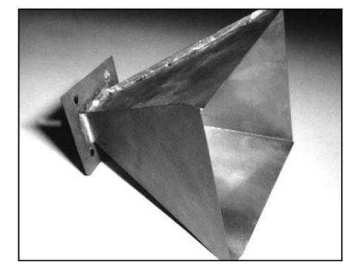
A Horn antenna is a type of aperture antenna which is specially designed for microwave frequencies. The end of the antenna is widened or in the horn shape. Because of this structure, there is larger directivity so that the emitted signal can be easily transmitted to long distances. Horn antennas operate in microwave frequency, so the frequency range of these antennas is super high or ultra-high which ranges from 300 MHz – 30 GHz.The energy of the beam when slowly transform into radiation, the losses are reduced and the focussing of the beam improves. A Horn antenna may be considered as a flared out wave guide, by which the directivity is improved and the diffraction is reduced. One of the first horn antennas was constructed in 1897 by Bengali-Indian radio researcher Jagadish Chandra Bose in his pioneering experiments with microwaves. The modern horn antenna was invented independently in 1938 by Wilmer Barrow and G. C. Southworth. This Horn model antenna is suitable employed in the UHF or SHF radio bands. Making this horn model antenna it will be easy for a beginner to make if it works in the 10GHz frequency, because small dimensions so it is not so difficult and also offers gain up to 25dBi.


The horn model antenna is usually fed (fed point) using waveguide. The propagation waveguide uses TE10 mode and works in normal frequency range. This means that the electric field (E) passes through the guide which has short dimensions and passes through a wide magnetic field (H). The terminology of E-plane and H-plane is as shown in the image below. There are many types of horn antennas, if the waveguide extends towards the H-plane it is called a sectoral H-plane. Similarly, if the waveguide is in the direction of the E-plane it is called a sectoral E-plan. If the waveguide is both plans it is called a pyramidal Horn antenna.

Pyramidal Horn Antenna with dimensional Parameters : (a) Overall Geometry; (b) Cross-section through xz-plane (H-Plane_ ; (c) Cross-section through yz-plane (E-Plane)

An illustration of a funnel antenna as shown in the image below. Long the center of the funnel to the center of the front of the funnel is denoted as L, and The length of the hypotenuse of the funnel is denoted L'. The difference between L and L' is of . This causes a phase difference in the electromagnetic field which through the aperture. This phase difference is allowed in the E-plan and H-plane. For the E-plane funnel the field intensity is fairly constant throughout the aperture. 

For Horn H-plane terrain will be tapered. As a result the phase difference at the edge of the aperture the E-plane the horn  is more critical and the phase difference should be less than 90 degree (1/4 lambda). In the H-plane  the horn allowable phase difference is 144 degree (0.4 lambda). If the aperture in the pyramidal funnel i.e. E-plane and H-plane exceeds one wavelength then the pattern becomes independent and can be analyzed separately.

Horn Antenna Gain

Horns have very little loss, so the directivity of a horn is roughly equal to its gain. The gain G of a pyramidal horn antenna (the ratio of the radiated power intensity along its beam axis to the intensity of an isotropic antenna with the same input power) is:

For conical horns, the gain is :

Where

A is the area of the aperture,
d is the aperture diameter of a conical horn
λ is the wavelength,
eA is a dimensionless parameter between 0 and 1 called the aperture efficiency,
The aperture efficiency ranges from 0.4 to 0.8 in practical horn antennas. For optimum pyramidal horns, eA = 0.511., while for optimum conical horns eA = 0.522. So an approximate figure of 0.5 is often used. The aperture efficiency increases with the length of the horn, and for aperture-limited horns is approximately unity

Horn Antenna Frequency Range

The operational frequency range of a horn antenna is around 300MHz to 30GHz. This antenna works in UHF and SHF frequency ranges.

Horn Antenna Radiation Pattern 

Radion patterns of pyramidal horn antenna (a) H-plane and (b) E-plane

The radiation pattern of a horn antenna is a Spherical Wave front. The following figure shows the radiation pattern of horn antenna. The wave radiates from the
aperture, minimizing the diffraction of waves. The flaring keeps the beam focussed. The radiated beam has high directivity.

Horn Antenna Design Example 


10GHz pyramidal horn antenna with approx. 18dBi visible gain like the picture below  The first parameter in planning the antenna are the gain and maximum antenna  size. These two things of course are related to each other, and can be estimated as follows.

L = H-plane length (λ) = 0.0654 × gain (Eq 1)
A = H-plane aperture (λ) = 0.0443 × gain (Eq 2)
B = E-plane aperture (λ) = 0.81 A (Eq 3)
Where :
Gain is expressed as a ratio, 20 dBi gain = 100 L, A and B are dimensions shown in Figure above. From the above equation for the dimensions of the antenna which has a gain 20dBi is a funnel that works in the 10.368GHz frequency. one length the band of 10.368GHz  is 1.138 inches. Length (L) of the funnel is 0.0654 x 100 = 6.54 lambda. At 10.368GHz. Appropriate aperture for the H-plan (A) horn is 4.43 lamda or 5.04 inches,  and the E-plan aperture is (B) 4.08 inches.
The easiest way to make such a horn antenna is to prepare the side pieces and solder them together. With Thus, the antenna material is made of metal that is easy  to solder. 


It is not recommended to use aluminum material, because it is difficult to manufacture. The dimensions of the triangular pieces are shown in Figure above.

Notice that the pieces of the triangle are trimmed at the ends of the which is tapered to fit the aperture of the waveguide (0.9 x 0.4 inch). This make the length 
from the base to the apex of the small triangle ( side B) shorter compared to side (A). Also note that the length S of the two sides different funnels must be the 
same in order to be assembled together. Need care must be taken in assembling this funnel antenna. The dimensions of the sides can be calculated by simple geometric math. But it will be easier if you make a pattern first on cardboard. From pattern cut and made an artificial funnel antenna first to make sure everything fits and  can be assembled together before cutting sheets of antenna material such as brass or copper.

Cut 2 pieces of cardboard for side A and side B and glue them together , in the form of a funnel. After that prepare a new sheet and cut 5.04 x 4.08 inches and 
punch a hole in the center to a size of 0.9 x 0.4 inches for the waveguide. If these dimensions are correct, use this cardboard pattern to mark or draw a pattern 
on a sheet of antenna material that actually. Cut the sheet of brass/copper antenna material carefully, because cutting errors will be fatal and you will lose
antenna material because it must be wasted. The next step is to put the parts together side by soldering. Remember the soldering part is the outside connection. 
Because if the part in the connection will affect its RF radiation and can reduce the gain of the funnel antenna.

reference :