Antenna Handbook: March 2020

Get Raspberi Pi 4 Tiny Single Board computer with highly efficient function


Raspberi Pi 4 , tiny computer with support 4K dual display monitor , choice of RAM from 1GB, 2GB, 4 GB, high speed Giga bit ethernet, with wireless networking and bluetooth support. 


Faster more Powerfull

Better Processor ,Faster data transfer speed,with fanless and low power supply for this tiny single board computer. Have 2 Port USB 2 ports and USB 3 ports, make transfer data ten times more faster. With application for robot brains, smart home hub, media centre, networked AI core, factory controller, and much more. Works compatible with old Raspberi model.

Amherst Researchers from University of Massachusetts , Tauhidur Rahman and Forsaid Al Hossain has invented a portable surveillance device powered by machine learning - called FluSense- using Raspberi Pi 4 , which can detect coughing and sneezing crowd size in real time, then analyze the data directly monitor flu-like illnesses and influenza trends.
The FluSense creators say the new edge-computing platform, envisioned for use in hospitals, healthcare waiting rooms and larger public spaces, may expand the arsenal of health surveillance tools used to forecast seasonal flu and other viral respiratory outbreaks, such as the COVID-19 pandemic or SARS.(umass.edu)

Spot X Satellite Messenger an important safety device for emergencies off grid


SpotX is Great Device for Camping, mount climber, hiking to your family and friends while you far from them. It sync with google map and your family and friends could know your position in the map , very save device and works very well in cold and rainy temperature, also there is features you can update to your social media twitter and facebook your realtime position and text message and email shows your exact GPS and altitude position. 
There is SOS button and if you press will exactly tell your family and friends exactly your  coordinate position. 
Spot X is great safety and emergencies device you can count in off grid area. 
71% Customers satisfied with SpotX , 29% giving 1-2 star on SpotX.
SpotX can exchange message and email from any virtual account anywhere in the world.
Can Sent SOS to 24/7 rescue center, can check tracking with certain interval time let your family and friends know you're ok and have interface with google maps. 

Winegard Portable Satellite Antenna Carryout G2+

Compare with old type G2, G2+ features a power inserter to provide single cable coax entry to the RV making set up and operation easier than ever before.


  • Compatible Satellite Providers: DIRECTV SD, DISH SD and HD, Bell SD and HD.
  • Compatible with DIRECTV receivers H24 and HR24. Not compatible with Dish Genie or Hopper receivers.
  • DIRECTV Satellites: 101° or 119°
  • Dish Satellites: 110°, 119°, 129°
  • Bell TV Satellites: 91° or 82°
  • Maximum Receiver Capability: 2
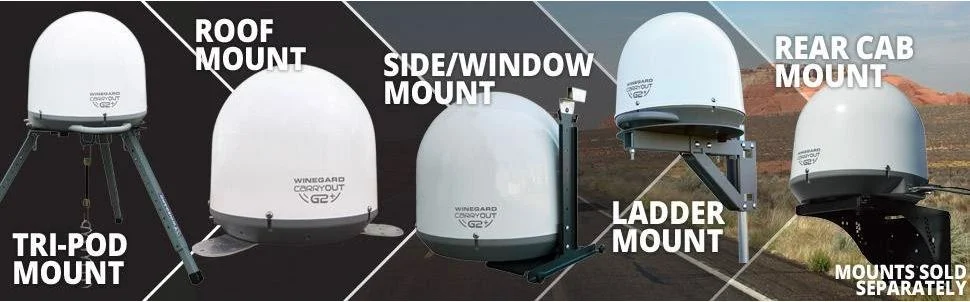
  • All Mounts Sold Separately
  • Stationary Use Only


This satellite dish worked as advertised. It is a breeze to set up, and once the receiver is activated, the reception of Direct TV came in very strong. The signal it got was very strong. This unit worked well in a strong thunderstorm when the RV was shaking with the wind. Remember, this unit only receives standard definition, but in our RV, with a 26" TV, the picture is very good. Also bear in mind, you need the older Direct TV receiver, for the standard definition. 

Pros :
  • Works Great
  • Easy To Setup
  • No Need External Outdoor Power

Cons :
  • Need Clear line of Satellite, Trees will cause Blockage

Best Jeep Cherokee XJ Antenna


Features 
  • This Antenna is Telescopic Antenna with dimension 13 inch length
  • Off Road 13 Inch Antenna 
  • For Jeep Cherokee XJ 1984 - 2001
  • Brand AntennaX

Price

AntennaX price for $15.99 on Amazon and same price at AntennaX  official website 


Installation


This Antenna will replace your old motorized genuine Antenna with this basic Antenna, so please think about before you buy.

Pros

  • It's ridge enough to stand yet flexible enough to bend out of the way for branches. It's an OFF-ROAD antenna
  • Good reception in the open country
  • Flexible when off roading

Cons

  • Several reviews complain about it being flimsy
  • A lot of interference reception in the city

How To Design Your Internet Client with Mikrotik Wireless Wire Dyna Dish, Mikrotik Router Board ?

When I design internet network  for Internet Service Provider Company , we used many Router, Switch and Antenna is Mikrotik Products.
And We have easily to design Google maps  and microsoft Paint and Microsoft Word , yes this is the easy way to design with tight budget.


Wireless Radio 


We used Mikrotik DynaDish  Point To Point Radio Antenna for Long Distance End Point , almost 40 km Line Of Sight  ( LOS) Distance in free space.

And We have the stable Internet connection and also in rainy days the quality is fair not drop.
Why We choose Mikrotik Equipment for this purpose ? For limited budget material and service , Our advised you choose Radio equipment with on budget and have stable quality. And Mikrotik it is Cheap, stable and also Easy to Setup and Maintain with IP Public. Most our network using Mikrotik, sure we also have Cisco, Aruba, TP Link, and etc. With 5 GHz free Radio frequency for Internet used.
Our recommendation for long distance used Mikrotik DynaDish , and you can find in here on Amazon. or at your nearest shop. 

Feature :
Product code :RBDynaDishG-5HacD
CPU :QCA9557 720 MHz
Size of RAM : 128 MB
10/100/1000 Ethernet ports : 1
Wireless : Built-in 5 GHz 802.11ac, dual-chain
Frequency range : 4920 - 6100 MHz (Operating range limited by Country Regulations)
Antenna gain : 25 dBi
Antenna beam width : 8
Wireless chip model : QCA9892
Port to port isolation : 23 db
Return loss : < 15 db
VSWR : 1.5
PoE in : Ye s
Supported input voltage : 11V - 60V passive PoE or : 802.3af/at with unshielded cable
Voltage Monitor : Yes
PCB temperature monitor : Yes
CPU temperature monitor : No
Dimensions : 404 mm, height 175 mm
(without mount)
License level : 3
Operating System : RouterOS
Max Power consumption : 9 W
Supported channels : 20/40/80 MHz


Router

On the Customer Side , if the customer connections more than one computer or other rooms must another internet connection you need a router. Choose Mikrotik RB750Gr3 5-port Ethernet or other similar brand products.

You can find this Products on Amazon, and other online store , and as my experienced with Mikrotik Products and the easiest GUI admin featured for setting up the Mikrotik from Accespoint, Wireless Radio and others products it will also reduce the maintenance cost , because you don't have to go onsite after onsite installation and turn on the Mikrotik, used IP Public on the customer site , setting the Miktrotik and you can regularly check from remote with IP Public.

Mikrotik hEX RB750Gr3 5-port Ethernet Gigabit Router is Router 5 Gigabit Ethernet Ports became our recommended router for small office, cafe, small restaurant in mall, or small shop and with Mikrotik Accesspoint 

Mikrotik hEX RB750Gr3 5-port Ethernet Gigabit Router


Our recommended for your clients used  Mikrotik hEX RB750Gr3 5-port Ethernet Gigabit Router, you can buy it in Amazon  , Recommended also by user.

Others alternative Mikrotik Routerboard for you, depends on your network design and 

Other related products of Mikrotik Routerboard for you.


Mikrotik RouterBOARD hEX lite 5 ports router 5 X 10/100 PoE OSL4 - (RB750r2)


MikroTik hEX S Gigabit Ethernet Router with SFP Port (RB760iGS)


Add to Cart


If you want to choose other related Mikrotik DynaDish Wireless Radio and Mikrotik Router Products please find here.

Best Chevy Silverado Antenna Replacement from Rydonair 13" inch Stubby Rubber


Do you feel annoyed often got problems in listening your favorite radio channels  while traveling in the city or outside the city? I often experienced this. Especially when outside the city or rural areas. Always got Bad Reception in my FM/AM Channels ? Reception Problems in Radio always occurs ?
While searching to solve this problem, I come up with this product on amazon , it is cheap product but it is offer to solve bad reception problems. And the material also made from Aluminum and with flexible rubber , so I am not to worried again for broken.

Features

  • High Quality Reception
  • 13 Inch Antenna
  • 1 Minute Installs No Tools Required
  • SiriusXM and Bluetooth Compatible
  • Design for either AM & FM Reception
  • Flexible Material
  • Compatible with Chevy and GMC Sierra, Denali


Please choose the right package Antenna connector for Chevy & GMC ranging from 2004-2008 Antenna production for Chevy between 2004-2008

Price :

$ 20.99

Pros :

  • Pickup Every Channel Include HD Channel
  • Works Well in Rural Area 60-70 miles 
  • In National Forest still in Good reception

Cons :

  • Normal Channel is Good, not able to pickup new HD Channels
  • Both AM & FM reduce far and issue with reception using 2018 GMC Sierra

Rydonair Antenna Installation Video


Best Omnidirectional Indoor Outdoor tv Antenna for Rural Areas

Now We look at this Omnidirectional Antenna from Channel Master.


Features

  • Channel Master with Digital Reception Range: 50+ Miles (360° Omnidirectional) is approximately 80 km, it is dipole Antenna in design.
I Think is suitable if you near the city or around the TV Stations Mast . And you can predict how long the distance your house from the TV Stations. If more 50 miles , I think this products is not for you.
  • Compatible with all HDTV's and 4K TV's
This means this product is compatible with digital TV Channel. 
  • Includes: Mounting Bracket for Mounting to a Wall, Mast Pole or an Existing Satellite Mount , and U bolt
  • Designed for Indoor or Outdoor Use on Roof, Attic, or RV
  • Easy to Install


Price

The Channel Master Omnidirectional Indoor/Outdoor HDTV Antenna Sale for $ 69.00.
With This Price , you will get Antenna and  Mounting Bracket , the price quite fair enough.

This Antenna if we look from physical views, is dipole antenna, And I do not see the information how much the dBi The Reception of Antenna and Also the dimension of antenna information not included. High dBi Rating means = further distance covered. So, with 50 miles distance covered reception is quite long distance around 80 km.


Pros 

  • Antenna Install Can Rotated Manually
  • Antenna Install can Pointing Manually for Better Reception
  • Install in Attic without Amplifier with 40+ channel with fairness reception.
  • Good Reception for Distance under 50 miles without amplifier needed UHF/VHF reception TV Networks
Cons
  • For more than 60 miles + Amplifier Signal Bar between 2-5 not for All Channels, amplifier needed

Installation

Channel Master Omnidirectional Antenna Indoor Outdoor HDTV Install on Direct Dish  

Channel Master Antenna Installation and signal strength

Channel Master Omnidirectional Antenna Assemble Video


Dish Playmaker Low Cost Redesigned Form from Winegard Antenna For Minimum Receiver

Dish Playmaker Portable Satellite Dish

This product RV Antenna only for 1 receiver.

Perfect for the RV, camper, motorhome, cabin, fishing, hunting, or tailgating.

Compatible with your current Dish subscription or Pay-As-You-Go programming providing convenience of no long contracts or commitments. Dish customers can add Pay-As-You-Go programming to their home account.


Improved Signal Strength

Features high-strength, military-grade aluminum reflector for improved signal strength. Up to 20% greater signal strength!

One of example Customer image Dish Playmaker Installed on their RV

Yagi Antenna

The fundamentals of our antenna project are described through basic antenna characteristics. In general this starts with establishing the antenna’s radiation pattern, gain and directivity.  The radiation pattern is a 2-D or 3D plot which assesses the intensity in which electromagnetic waves propagates as a function of orientation. The gain of an antenna indicates how well the signal power amplifies in one direction, where its directivity characterizes the direction and magnitude of maximum power amplification. 

 The design of a Yagi (Yagi-Uda) antenna requires proper understanding of how the components are structured and how varying the lengths and position of these components changes the characteristics of the antenna. The components include a driver, reflector(s), and a number of directors.  The driver is the single active element which is excited by a signal, while the reflector(s) re-radiate by reflecting the signal and directors re-radiate by directing the signal. For this reason both the reflector(s) and directors are considered as parasitic elements.  A common starting point for a design begins with selecting the length of the director such that is it slightly less than one-half of the intended operating wavelength. In the report other general guidelines and specific details showcase the design choices as they relate to antenna performance.  In addition to our design we have examined the characteristics of a commercially available Yagi Antenna that being the WSJ-1800 which operates at 2.4 GHz as well. 


Theory 

 Antennas are devices that transmit or receive electromagnetic waves. If an antenna is receiving a signal it converts the incident electromagnetic waves into electrical currents; if it is transmitting it does the opposite. Antennas are designed to radiate (or receive) electromagnetic energy with particular radiation and polarization properties suited for its specific application. The Yagi antenna is a directional antenna which consists of a dipole and several parasitic elements. 

The parasitic elements in a Yagi antenna are the reflectors and the directors. A Yagi antenna typically has only one reflector which is slightly longer than the driving element (dipole) and several directors, which are slightly shorter than the driving element. The Yagi antenna is said to be directional because it radiates power in one direction allowing it to transmit and receive signals with less interference in that particular direction. Figure 1 is a diagram of the general configuration of a Yagi antenna. 

Figure 1. Yagi Antenna Configuration 


The directionality of an antenna can be determined from the relative distribution characteristics of the radiated power from the antenna; this is known as an antenna’s radiation pattern. Given the electric and magnetic field patterns of an antenna, the time average Poynting vector, also known as the power density equation, can be obtained using the following formula:


Where E and H are the electric and magnetic field equations. The radiation pattern is typically described in terms the normalized radiation intensity, which is given by: 

Where R is the range, θ is the called the elevation plane which corresponds to a constant value of φ . If φ = 0 then the x-z plane is defined. The φ angle is referenced through the azimuth plane and specified by θ = 90° (x-y plane). Figure 2 summarizes these parameters. 

Figure 2. Definition of R ,θ , andφ . 

The radiation pattern of a Half-Wave Dipole Antenna is shown below. Once the electric and magnetic field equations for the Half-Wave Dipole Antenna are solved then a radiation pattern can be calculated. Please refer to the Appendix for the derivation of the electric and magnetic wave equations which lead to the calculation of the radiation pattern.

 Figure 3. Half-Wave Dipole Antenna and Radiation Pattern


Notice that the Half-Wave Dipole Antenna radiates its power equally in a radial fashion, along the x-y plane in Figure 3. The radiation pattern for a commercial MFJ-1800, a 2.4 GHz Wi-Fi operation Yagi antenna is shown below. Refer to the Appendix for an abbreviated derivation of the radiation pattern of a Yagi antenna. 

Figure 4. MFJ-1800 Yagi Antenna and its Radiation Patten 


Notice that the radiation pattern shows a very directive beam, which indicates that the MFJ-1800 Yagi Antenna radiates with the greatest directional power along the xdirection. The general guidelines for determining the size and shape of a Yagi antenna include accounting for the reflector length, driver length, director lengths, reflector to driver spacing, driver to first director spacing, and the spacing between the directors. The directional gain of a Yagi antenna is typically 7-9dB per λ (wavelength) of overall antenna length (given as a multiple of wavelengths). 

There is little to no gain by the addition of more than one reflector. Adding directors however, does increases the overall directive gain of the antenna, but not indefinitely. Generally the reflector length is slightly greater than λ/2, the driver and director lengths are slightly less than λ/2, director lengths are typically between 0.4-0.45λ. The reflector to driver spacing is about λ/4. 

The spacing between directors can be between n 0.2 to 0.4λ, but be aware when the director spacing is greater than 0.3λ the overall gain of the antenna is decreased by 5-7dB. Procedure The Yagi antenna that was built for this project was made from an aluminum sheet. The aluminum sheet was cut out using pliers and filed down to the specific dimensions. The driving element was shaped from a thin plastic sheet and then covered with copper tape. 

The Yagi antenna was built this way for two reasons: the aluminum sheet and copper tape were cheap and also easy to work with. The drawback of cutting out the Yagi antenna from an aluminum sheet was that the design became final upon cutting and no further adjustments are then possible.


Figure 5. Cutting out the parasitic elements. The final design. 


Figure 6 is a general schematic of the Yagi antenna which was built. The six lengths that are listed in the schematic are of the specific lengths that were previously explained. The list below summarizes those lengths.

 Î» = c / f = (3x10⁸ ) / (2.4*109 ) = 0.125m = 125 mm 
L1 (director spacing) ≈ 42 mm = 0.34 λ 
L2 (driver to director) ≈ 35 mm = 0.28 λ 
L3 (reflector to driver) ≈ 35 mm = 0.28 λ 
L4 (directors length, < (λ/2) < L5) ≈ 41 mm = 0.33 λ 
L5 (driver length, < (λ/2)) ≈ 60 mm = 0.48 λ 
L6 (reflector length, > L5 > (λ>2)) ≈ 64 mm = 0.51 λ 
L7 (antenna length) ≈ 200 mm = 1.6 λ 
Expected gain = 1.6 λ (7dB/ λ) – 5dB = 6.2dB

The expected gain is antenna gain was calculated by using two of the general rules for designing a Yagi antenna. These rules were described in the Theory section of this report. Expect a 7-9dB gain per λ (overall length of antenna) and also a 5-7dB loss if the director lengths exceed 0.3 λ. In our design the antenna was 1.6 λ in total length and the drivers were slightly over 0.3 λ so we naturally assumed about a 5dB loss.


In order to determine how our Yagi antenna would radiate we decided to use a very common software application which calculated and plotted the three dimensional radiation patterns for typical antennas. This professional software tool is called Super NEC 2.9, which we obtained a 30-day trial version which has functions that integrated with MATLAB. Super NEC has a built-in template for a Yagi antennas which allowed us to simply input the Yagi antenna’s element spacing’s and Super NEC generated a three dimensional model of the antenna, as shown in Figure 7. 


Once the antenna has the desired dimensions, then Super NEC can generate three dimensional radiation plots of the antenna. As shown on Figure 8. 

As expected the predicted directivity gain (at max) is 6.2dB, which aligned with our predicted expectations. 

Results 

 We verified our design at Palm, Inc. Palm has a calibrated setup for measuring radiation patterns of antennas. The first step that was taken prior to placing the antenna in a chamber for measurements was to verify that the antenna could in fact transmit a signal. With the use of a spectrum analyzer the S11 parameter was measured; if the S11 had been 0dBm this indicates the entire signal that is being put into the antenna is reflected back and not transmitted at all. Ideally we want the S11 to be as low as possible at the desired operating frequency. 

As the graph shows the antenna transmitted the best at about 2.3GHz, which is not the intended frequency of 2.4GHz, yet it still performs well at 2.4GHz with the S11 parameter at -6dB. This low value indicates that the antenna does transmit at the operating frequency, but could improve its efficiency from a more optimized design. 

 Once we verified that the Yagi antenna did in fact transmit then we placed it in the radiation chamber (Figure 10). Inside this chamber the antenna is mechanically rotated while an automated program gathered all the relevant data then generated a three dimensional radiation pattern graph as shown in Figure 11. The measured radiation pattern yielded 5.54dB gain which is 0.7dB less than what we had expected.


Reference : EE 172 Extra Credit Project 2.4 GHz Yagi-Uda Antenna Created by Mario Delgadillo Maringan Pardamean Panggabean , San Jose University