Antenna Handbook | Best Antennas, Free Calculators & Top Antenna Deals

Comparison Long Range tv antenna for rural areas : GE Outdoor TV Antenna VS Antennas Direct Outdoor Antenna

Rural areas consist of savanna , mountain, trees, with hilly land , far away from Broadcasting TV Tower and need Antenna TV Outdoor/Indoor with High Gain for reach the signal from the TV transmitting tower.


With todays many cellular tower in the rural areas, and affect TV signal reception , we also need cellular filter 3G/4G/5G.

For this purpose I will compare GE Outdoor TV Antenna VS Antennas Direct Outdoor Antenna with keys criteria for you as reference.

If you live in USA and Canada please check your coverage in FCC website. 

Check Coverage

Use dtv reception maps   to check for the DTV signals that are available at your location. Enter your address in the box at dtv reception maps and click Go! The DTV coverage map will list all stations in your area.

Sometimes stations change the frequency on which they broadcast — the channel a viewer selects to watch a particular station remains the same but the frequency that the viewer’s television finds the station on changes -- requiring viewers who use an over-the-air antenna to rescan their tuners to locate the station's new signal.


DTVmaps is a tools to help you decided what the right antenna for your TV, based on coverage distance. 

Actual signal strength may vary based on a variety of factors, including, but not limited to, building construction, neighboring buildings and trees, weather, and specific reception hardware. Your signal strength may be significantly lower in extremely hilly areas.


Comparison chart

Below the chart comparison  is a key to explain each of the measurements and what to compare depending on your needs.


The keys factor you need to know for pick the Antenna Outdoor are :

Brand 

General Electric Company (GE) is an American multinational conglomerate incorporated in New York State and headquartered in Boston. As recently as 2018, the company operated through the following segments: aviationpowerrenewable energydigital industryadditive manufacturinglocomotives, and venture capital and finance . One of GE products are home appliances included TV Antenna.

Antennas Direct is An Antenna company in 16388 Westwoods Business Park Ellisville, MO 63021, whose acquired Mohu Antenna in 2003, have more than 100 employees, and produce Innovative HDTV Antennas, Broadcast Television, Digital Antennas, TV Antennas, OTA Television, Television Accessories

Different manufactures produce Outdoor Antenna which meet today’s good reception standards antenna. The chart shows the criteria for you considered to picks the antenna 

Model

The 2 Antenna model name shown are different, GE model with J mount and designed for reduce signal dropouts and for UHF, VHF, HDTV reception, claims by customer to have power reception around 16-20 dB  can installed both Outdoor, Attic and Indoor .

While Antenna Direct model with 8 element bowtie, also can installed in Outdoor, Attic, and Indoor and have around 17.4 dB power reception, it is strong enough to receive long distance broadcast TV Tower.

Filter


Lte filter can remove interference from frequency bands (3G/4G) outside the TV band. It can improve the TV signal.
Passes range 80 to 800MHz,Blocked 800MHz above.4g filter removes noise for better picture. Antenna Filter - Cleaning unwanted RF signal out of digital antenna system effectively,Signal loss is 0.8dB or less.


Booster

Signal booster enhances any non-amplified antenna, delivering a clearer signal, more range, and more available channels; works with any passive/non-amplified antenna; antenna required for use with preamplifier.
This questions must apply before you buy the booster :
Are your home/house far away from TV Tower Stations and also have weak signal reception from Outdoor/Indoor Antenna ? If the Answers is Yes, than you should use Booster Antenna.

Range Max (in Miles)

Range Antenna for pick up TV signal influenced by Elements of Antenna and Gain , the more elements your antenna have, the more Gain of the Antenna, and more sensitive to pick signal from far away

Gain (in dBi)

As mention above, the more Gain the antenna have, the more good quality for antenna pick up signal.
If the antenna have Gain between 15-35db , it is good enough for receiving TV signal from long range area.

Band (Frequency in MHz)

Band frequency for Digital HDTV, VHF, and UHF band between 470-860 MHz , sometimes antenna manufacturing company also made antenna covering FM Band, between 45-860 MHz.


Price

Price will vary, you can get the cheapest antenna with price below USD 30 , or the expensive one with price more than USD 200, it is depends your need, as long as you have the good quality of antenna, with the good reception and your satisfied , the price will not be the issue.

Omnidirectional Dipole HDTV Outdoor Digital Antenna

Now We look at this Omnidirectional Antenna from Channel Master.


Features

  • Channel Master with Digital Reception Range: 50+ Miles (360° Omnidirectional) is approximately 80 km, it is dipole Antenna in design.
I Think is suitable if you near the city or around the TV Stations Mast . And you can predict how long the distance your house from the TV Stations. If more 50 miles , I think this products is not for you.
  • Compatible with all HDTV's and 4K TV's
This means this product is compatible with digital TV Channel. 
  • Includes: Mounting Bracket for Mounting to a Wall, Mast Pole or an Existing Satellite Mount , and U bolt
  • Designed for Indoor or Outdoor Use on Roof, Attic, or RV
  • Easy to Install

Price

The Channel Master Omnidirectional Indoor/Outdoor HDTV Antenna Sale for $ 69.00.
With This Price , you will get Antenna and  Mounting Bracket , the price quite fair enough.

This Antenna if we look from physical views, is dipole antenna, And I do not see the information how much the dBi The Reception of Antenna and Also the dimension of antenna information not included. High dBi Rating means = further distance covered. So, with 50 miles distance covered reception is quite long distance around 80 km.


Pros 

  • Antenna Install Can Rotated Manually
  • Antenna Install can Pointing Manually for Better Reception
  • Install in Attic without Amplifier with 40+ channel with fairness reception.
  • Good Reception for Distance under 50 miles without amplifier needed UHF/VHF reception TV Networks
Cons
  • For more than 60 miles + Amplifier Signal Bar between 2-5 not for All Channels, amplifier needed

Installation

Channel Master Omnidirectional Antenna Indoor Outdoor HDTV Install on Direct Dish  

Channel Master Antenna Installation and signal strength

Channel Master Omnidirectional Antenna Assemble Video


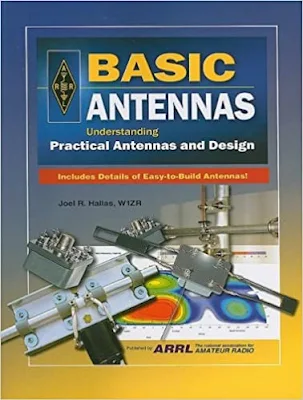
Arrl Antenna Book Review : Basic Antennas, Understanding Practical Antennas and Design

This Book written by Joel R. Hallas cover Basic Antennas Design and Practical with 26 Chapter and 2 Appendix  , suitable for college,student, and hobbyists and other enthusiasm in Antenna field.

Very good book for Professional and Amateur Enthusiasm for reference DIY Antennas , and how to design and build Do It by Yourself.

From Chapter 1, discuss about what an antenna is ? , the concept of antenna with Practical understanding and example in Practical and real life. 
Chapter 2, Half Wave Dipole Antenna in Free Space 
Chapter 3, The Field from a Dipole Near The Earth
Chapter 4, The Impedance of Antennas
Chapter 5, Transmission Lines
Chapter 6. Making Real Dipole Antennas
Chapter 7, The Field From Two Horizontal Dipoles 
Chapter 8, The Field From Two Vertical Dipoles
Chapter 9, Transmissions Lines as Transformers
Chapter 10, Practical Two Element Antenna Arrays 
Chapter 11, Wideband Dipole Antennas
Chapter 12, Multiband Dipole Antennas 
Chapter 13, Vertical Monopole Antennas
Chapter 14, Arrays of Vertical Monopole Antennas
Chapter 15 Practical Multielement Driven Arrays
Chapter 16, Surface Reflector Antennas
Chapter 17, Surface Reflector Antennas You Can Build
Chapter 18, Antenna Arrays With Parasitically Coupled Elements
Chapter 19, The Yagi-Uda or Yagi, Parasitically Coupled Antenna
Chapter 20, Practical Yagis for HF and VHF
Chapter 21,Log Periodic Dipole Arrays
Chapter 22,Loop Antennas
Chapter 23, Loop Antennas You Can Build
Chapter 24, Antennas for Microwave Applications
Chapter 25, Vehicle Antennas
Chapter 26, Antenna Measurements
Appendix A Getting Started in Antenna Modeling with EZNEC
Appendix B Using Decibels in Antenna Calculations Index

Make A Simple Halfwave Dipole Antenna for TV

In this article I will show you how to make simple a halfwave dipole antenna for home TV reception using 2 radiators , consist of two 1/4L coaxial cable and feed point .
The video for how to make this simple antenna also you can watch on my youtube channel.

Digital TV frequency band is 470-800 MHz , depends on your country and location, you can adjust with your own frequency used. So, based on that frequency , we will design the radiator Length (L) of Antennas, as in Simple A Halfwave Principle Antenna Design .


For High Frequency, we used formula :

                                                                 L = 468/Fmhz 

Center Frequency of 470-800 MHz is 635 MHz

                                                                L = 468/635
                                                                 
                                                                   = 0.737 ft

                                                                   = 0.113 meter  (approximately)
                              
                                                                   = 11.3 cm

                                                          1/2L  = 5.65 cm

So, we will make 2 radiators using coaxial cable with length 5.65 cm each

Wire Direction Antenna

A directional antenna has the ability to enhance reception of desired signals, while rejecting undesired signals arriving from slightly different directions. Although directivity normally means a beam antenna, or at least a rotatable dipole, there are certain types of antenna that allow fixed antennas to be both directive and variable.


See Chap. 7 for fixed but variable directional antennas and Chap. 11 for fixed and non-variable directive arrays. Those antennas are transmitting antennas, but they work equally well for reception. This section shows a crude, but often effective, directional antenna that allows one to select the direction of reception with pin plugs or switches.

Consider Fig. 13-10. In this case, a number of quarter-wavelength radiators are fanned out from a common feedpoint at various angles from the building. 

At the near end of each element is a female banana jack. A pair of balanced feedlines from the receiver (300-Ω twin lead, or similar) are brought to the area where the antenna elements terminate. 

Each wire in the twin lead has a banana plug attached. By selecting which banana jack is plugged into which banana plug, you can select the directional pattern of the antenna. If the receiver is equipped with a balanced antenna input, then simply connect the other end of the twin lead direction to the receiver. 

Otherwise, use one of the couplers shown in Fig. 13-11. Figure 13-11A shows a balanced antenna coupler that is tuned to the frequency of reception. 

The coil is tuned to resonance by the interaction of the inductor and the capacitor. Antenna impedance is matched by selecting the taps on the inductor to which the feedline is attached. A simple RF broadband coupler is shown in Fig. 13-11B. 

This transformer is wound over a ferrite core, and consists of 12 to 24 turns of no. 26 enameled wire, with more turns being used for lower frequencies, and fewer for higher frequencies. Experiment with the number of turns in order to determine the correct value. 

Alternatively, use a 1:1 balun transformer instead of Fig. 13-11B; the type intended for amateur radio antennas is overkill powerwise, but it will work nicely.


Field Strength Meter Circuit Diagram For CB Radio 27 MHz SSB

This meter can often help you get better signal transfer between antenna and transceiver than an SWR meter. 
 

The Circuit 

You can make your own field strength meter for just a few dollars by following this circuit diagram. Wiring is not critical , but use metal housing.


Buil This High Gain Rhombic TV Antenna

This Rhombic Antenna was from Popular Electronics Magazine October 1975 Edition. Cheap cost Antenna , and if your roof house non metallic can match with contour house. Easy to build and Install , provides good reception , almost 14 dB gain. It can be installed without support masts. High gain, broad bandwidth and good directionallity are characteristic of the rhombic's performance.

Rhombic Antenna Design 

 The first step in designing the rhombic is to decide what channels you want to recieve.

The relative location of their transmitting antennas with respect to your home. And the physical layout of the installation site ( we assume the antenna is mounted horizontally on the pitched roof of wood house) , for modern today house we should move antenna to outside of roof, because today house construction using steel frame.

For optimum result three basic designs are given, covering VHF Lo, VHF Hi, and UHF Bands. The VHF Lo Antenna measures 25 Feet ( 7.6 m) on a side and cover channels 2 through 6 and the FM Broadcast Bands.
The VHF Hi design , spanning channels 7 through 13, has legs one-third the length of those for VHF Lo.


Our TV Antenna Type and Specification List we can offer

TV Antenna 
Type : YNX-HD-T-C01


Specification 


Minimal Quote : 100 pcs , maximum Quote : 5000 pcs


TV Antenna 
Type : YNX-HD-T-C02

Specification :


Minimal Quote : 100 pcs , maximum Quote : 5000 pcs


Type TV Antenna
YNX-HD-T-C03


Specification
Minimal Quote : 100 pcs , maximum Quote : 5000 pcs


Type TV Antenna
YNX-HD-T-C04

Specification
Minimal Quote : 100 pcs , maximum Quote : 5000 pcs


Type TV Antenna

YNX-HD-T-C05


Specification


Minimal Quote : 100 pcs , maximum Quote : 5000 pcs


Build The Microcomputer SAP-1 (Continues 1)

As described in article before about the architecture of Microcomputer SAP-1 , in this article we will continue with other part of Microcomputer Diagram Block and circuit .
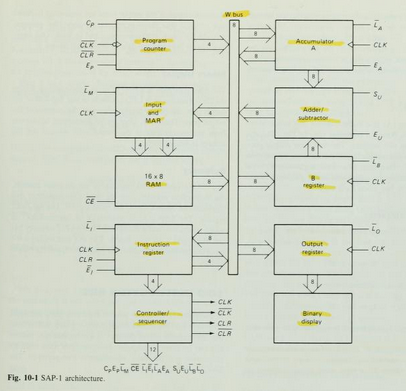
For you reference , in figure 10-1 as described  have Instruction Register, Accumulator, B Register, Output Register, and Binary Display, We will describe all about it in this article.


Instruction Register

The Instruction register is part of the control unit. to fetch an instruction from the memory the computer does a memory read operation. 

This places the contents of the addressed memory location on the W bus . At the same time, the instruction register is set up for loading on the next positive clock edge.

The contents of the instruction register are split into two nibbles. The upper nibble is a two-state output that goes directly to the block labeled "Controller sequencer". The lowe nibble is a three-state output that is read onto the W bus when needed.

Controller-Sequencer

The lower left block contains the controller-sequencer. Before each computer run, a Low CLR signal is sent to the program counter and a CLR signal to the instruction register.
 

Kivy Example Program "Hello World"


class TestApp(App):
     
            def build(self):  
                return Button(text='Hello World')  
TestApp().run()

Copy and paste the program listing above into Python Shell 2.7.18 or Python Shell 
3.x then save with the name HelloWorld.py, and run with the Run Module.


Build The SAP-1 Microcomputer

This articles is from Book of Digital computer electronics : an introduction to microcomputers , book written by Albert Paul Malvino.

The SAP (Simple-As-Possible) computer has been designed for the beginner. The Main Purpose of SAP is to introduce all the crucial ideas behind computer operation without burying you in unnecessary detail. But even a simple computer like SAP covers many advanced concepts. to avoid bombarding you with too much all at once, we will examine three different generations of the SAP computer.

SAP-1 is the first stage in the evolution toward modern computers. Although primitive, SAP-1 is a big step for a beginner. So, dig into SAP-1, master SAP-1, its architecture, its programming , and its circuits, Then you will be ready for SAP-2. 

The Architecture 


Figure 10-1 shows the (structure) of SAP-1, a bus-organized computer. All register outputs to the W bus are three-state; this allows orderly transfer of data . All other register outputs are two-state; these outputs continuously drive the boxes they are connected to.

The layout of fig. 10-1  emphasizes the registers used in SAP-1. For this reason , no attempt has been made to keep all control circuits in one block called the control unit, all input-output circuits in another block called the I/O unit, etc.

many of registersof Fig. 10-1 are already familiar from earlier examples and discussions. What follows is a brief description of each box; detailed explanations come later.

The Circuit Diagram


Program Counter

The program is stored at the beginning of the memory with the first instruction at binary address 0000, the second instruction at address 0001, the third at address 0010, and so on. The program counter, which is part of the control unit, counts from 0000 to 1111. It is job is to send to the memory the address of the next instruction to be fetched and executed. It does this as follows.

The Program Counter is reset to 0000 before each computer run. When the computer run begins, the program counter sends address 0000 to the memory. The program counter is then incremented to get 0001. After the first instruction is fetched and executed, the program counter sends address 0001 to the memory. Again the program counter is incremented. After the second instruction is fetched and executed, the program counter sends address 0010 to the memory. In this way, the program counter is keeping track of the next instruction to be fetched and executed.

The program counter is like someone pointing a finger at a list of instructions, saying do this first, do this second, do this third, etc. This is why the program counter is sometimes callled a pointer; it points to an address in memory where something important is being stored. 


Input and MAR

Below the program counter is the input and MAR block. It includes the address and data switch registers. These Switch registers, which part of the input unit, allow you to send 4 address bits and 8 data bits to the RAM. As you recall, instruction and data words are written into the RAM before a computer run.

The Memory address register (MAR) is part of the SAP-1 memory. During a computer run, the address in the program counter is latched into the MAR. A bit later, the MAR applies this 4-bit address to the RAM, where a read operation is performed.

The RAM

The RAM is a 16 X 8 static TTL RAM. You can program the RAM by means of the address and data switch registers. This allows you to store a program and data in the memory before a computer run.
During a computer run, the RAM receives 4-bit addresses from MAR (Memory Address Register) and a read operation is performed, In this way , the instruction or data word stored in the RAM is placed on the W bus for use in some other part of the computer. 

On the next article, I will describe  Instruction register, controller sequencer, Accumulator/A Register, Adder/Subtractor, B Register, Output Register, and Binary Display.

What is Filter Circuit ?

filter is a circuit that is capable of passing a specific range of frequencies while block-ing other frequencies. The four major types of filters include low-pass filters, high-pass filters, bandpass filters,and notch filters(or band-reject filters). A low-pass filter passes low-frequency components of an input signal, while a high-pass filter passes high-frequency components. A bandpass filter passes a narrow range of frequencies centered around the filter’s resonant frequency, while a notch filter passes all frequencies except those within a narrow band centered around the filter’s resonant frequency

 Filters have many practical applications in electronics. For example, within a dc power supply, filters can be used to eliminate unwanted high-frequency noise present within the ac line voltage, and they act to flatten out pulsing dc voltages generated by the supply’s rectifier section. 

In radio communications, filters make it possible for a radio receiver to provide the listener with only the desired signal while rejecting all others. 

 Likewise, filters allow a radio transmitter to generate only one signal while attenuating other signals that might interfere with different radio transmitters’ signals. 

In audio electronics, filter networks called crossover networks are usedt o divert low audio signals to woofers, middle-range frequencies to mid range speakers, and high frequencies to tweeters. 

The list of filter applications is extensive.There are two filter types covered in this chapter, namely, passive filter sand active filters. 

Passive filters are designed using passive elements (e.g., resistors, capacitors,and inductors) and are most responsive to frequencies between around 100 Hz and 300 MHz. 

The lower frequency limit results from the fact that at low frequencies the capacitance and inductance values become exceedingly large, meaning prohibitively large components are needed. 

The upper frequency limit results from the fact that at high frequencies parasitic capacitances and inductances wreak havoc.) 

When designing passive filters with very steep attenuation falloff responses, the number of inductor and capacitor sections increases. 

As more sections are added to get the desired response, the greater is the chance for signal loss to occur. Also, source and load impedances must be taken into consideration when designing passive filters. 

Active filters, unlike passive filters, are constructed from op amps, resistors, and capacitors—no inductors are needed. Active filters are capable of handling very low frequency signals (approaching 0 Hz), and they can provide voltage gain if needed(unlike passive filters). 

Active filters can be designed to offer comparable performance to LC filters, and they are typically easier to make, less finicky, and can be designed without the need for large-sized components. 

 Also, with active filters, a desired input and output impedance can be provided that is independent of frequency. One major drawback with active filters is a relatively limited high-frequency range. 

Above around 100 kHz or so, active filters can become unreliable (a result ofthe op amp’s bandwidth and slew-rate requirements). 

At radio frequencies, it is best to use a passive filter

(from Book :  Practical Electronics for Inventors by : Paul Scherz)

Write Now Programmer universal ic programmer kit

Our company is representative for Algocraft Device Programmers, Please contact me for device programmers inquiries Writenow programmers and Writebefore programmers. We shipping worldwide !

Main Features

  • Ultra-fast, universal In-System Programmers
  • True parallel, program up to 8 devices at once
  • Industrial-grade reliability
  • Standalone operations or host controlled
  • Easy to install and to use
  • Compact size, fixture friendly

Introduction

Based on the proprietary WriteNow! Technology, the WriteNow! Series of In-System Programmers is a breakthrough in the programming industry. The programmers support a large number of devices (microcontrollers, memories, CPLDs and other programmable devices) from various manufacturers and have a compact size for easy ATE/fixture integration. They work in standalone or connected to a host PC (RS-232, LAN and USB connections are built-in), and are provided with easy-to-use software utilities.

Features

  • Supports microcontrollers, serial and parallel memories, CPLDs and other programmable devices
  • High-speed, parallel programming
  • Compact size (fixture friendly)
  • Standalone operations or host controlled
  • Designed for easy ATE interfacing
  • Robust and reliable
  • Supports multiple interfaces (JTAG, BDM, SPI, I2C, UART, etc.)
  • Memorizes data on a built-in memory card
  • Programmable power supply output (1.5-13V)
  • Programmable I/O voltage (1.6-5.5V)
  • High-speed I/O
  • USB, LAN, RS-232 (isolated) and low-level interface (isolated)
  • ISP I/O relay barrier (only available on the single-site model)
  • I/O protection
  • Wide range power supply (12-24V)

Powerful and Easy-to-Use Software Utilities

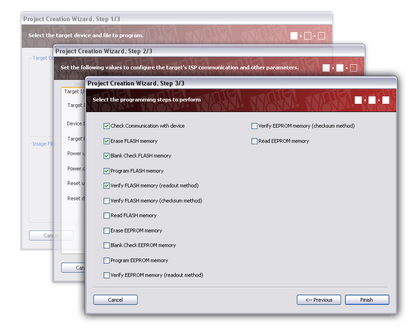
The WriteNow! Series of In-System Programmers can be controlled by a host PC through simple, ASCII strings through a standard terminal interface. On top of that, a powerful user interface is provided which allows to setup and control the instruments through easy, graphical procedures. The WriteNow! Project Generator guides you through the creation and debugging of a programming Project in a few guided steps: device selection, source file creation, board parameter settings, programming flow options, upload and run of the Project.


Models

The WriteNow! Series of In-System Programmers is available in four models, which share a common in-system programming core. Single-site model features a relay barrier on ISP I/O lines.
WN-PRG01A Single-Site In-System Programmer
WN-PRG02A 2-Site In-System Programmer
WN-PRG04A 4-Site In-System Programmer
WN-PRG08A 8-Site In-System Programmer

External Relay Barriers

External relay barriers are available as accessories for multiple-site WriteNow! models.
WN-REB04A Relay Barrier Module for WN-PRG02A and WN-PRG04A
WN-REB08A Relay Barrier Module for WN-PRG08A

Demultiplexer Modules

WN-DM2X2A Demultiplexer Module for WN-PRG02A (4 Channels + Relay Barrier)
WN-DM2X3A Demultiplexer Module for WN-PRG02A (6 Channels + Relay Barrier)
WN-DM2X4A Demultiplexer Module for WN-PRG02A (8 Channels + Relay Barrier)
WN-DM4X2A Demultiplexer Module for WN-PRG04A (8 Channels + Relay Barrier)
WN-DM4X3A Demultiplexer Module for WN-PRG04A (12 Channels + Relay Barrier)
WN-DM4X4A Demultiplexer Module for WN-PRG04A (16 Channels + Relay Barrier)
WN-DM8X2A Demultiplexer Module for WN-PRG08A (16 Channels + Relay Barrier)
WN-DM8X3A Demultiplexer Module for WN-PRG08A (24 Channels + Relay Barrier)
WN-DM8X4A Demultiplexer Module for WN-PRG08A (32 Channels + Relay Barrier)

Silicon Support

  • Adesto
  • Atmel
  • Cypress
  • Giga Device
  • Infineon
  • Microchip
  • Micron
  • Nordic Semiconductor
  • NXP (Freescale)
  • Renesas
  • Sigma Designs
  • Silicon Labs
  • Spansion
  • SST
  • ST Microelectronics
  • Texas Instruments
  • Winbond
New manufacturers and devices are constantly added. Contact us for more information.

Additional Information

You can request additional information through our Information Request Form.