Antenna Handbook

Best HR Software Solutions for 2022

 Best Human Resources Software

We may be compensated by vendors who appear on this page through methods such as affiliate links or sponsored partnerships. This may influence how and where their products appear on our site, but vendors cannot pay to influence the content of our reviews. For more info, visit our Terms of Use page.

Top HR software recommendations

To help you in your search for the best human resources software, we’ve compiled a list of the top-rated HRM software according to their features. Read on after the comparison chart for more information on how online HR and payroll software can help your company, or fill out the Product Selection Tool at the top of the page to get free custom recommendations according to your needs.

Table of Contents

What is HR software?

Back to top ↑

The growing human resources (HR) software market is forecasted to reach $33.58 billion by 2026. While most companies and individuals are somewhat familiar with HR and payroll software packages and online HR systems, the landscape is rapidly changing with the addition of new best-of-breed apps and HR tools to keep pace with the ways changing technology affects how users want to interact with software.

In its inception as licensed on-premise software, HR management software was restricted to employee data, payroll, and benefits. But the HRM software market has expanded significantly due to automated workflows and demand for cloud technology. These changes in customer expectations and the greater willingness of the workforce to use self-service models now mean HR tasks like payroll, time-off requests, benefits management, and org charts take up less administrative time, which frees up the HR team to focus their attentions on recruiting, employee experience, workforce management, company culture, branding, and other tasks that now fall under the descriptor of talent management.

Compare the best online HR tools

Types of multi-tool on-premise or cloud HR solutions

Back to top ↑

  • Human Resources Management Systems (HRMS)
  • Human Resources Information Systems (HRIS)
  • Talent Management Software
  • Human Capital Management (HCM)
  • Core HR Software
  • HR Administration software

Best of breed SaaS categories within HR software

Back to top ↑

For in-depth information on each of these categories, click on the link to visit the category overview page.

There has been little movement in traditional segments of the HRM software market since the first on-premise solutions were introduced in the late 1980s. HR and payroll software, time and attendance, and benefits management are the staple HRMS products, along with storing employee information. Market growth and consolidation are driven by emerging HRM software technology that makes the systems lighter and more available to SMBs, as well as new trends in HR management strategies like performance and talent management.

Human resource management software giants like OracleSAP, and ADP invested in multi-tool HRM software and have stayed competitive in the rapidly changing marketplace by acquiring successful startups and integrating those human resources tools and HR analytics into their current HR platforms. We can expect to see this trend continue, as startups have more flexibility to move quickly on emerging technologies and established core HR companies have the capital to acquire them.

Best HRM software vendors by specialty

Back to top ↑

HRISPerformance ManagementATS & RecruitingLearning ManagementEmployee Engagement
WorkdayUKG (formerly   Kronos)ICIMS RecruitSAP LitmosFortay
SAP SuccessFactorsSabaBullhornHalogen TalentspaceDarwinbox
ADPBambooHRJazzHRCornerstone15Five
Zoho PeopleEngagedlyBreezy HRTalentLMSKudos

Categories of HRM software solutions

Back to top ↑

Human resources information systems (HRIS)

Human Resources Information System (HRIS) software is an umbrella term that includes as many distinct types of software as there are online HR software companies. These products are known by many different names, but the purpose of these multi-function systems is to store individual employee data, manage payroll and benefits administration, and manage the company’s regulatory and legal employment requirements.

Although the amount of time that HR managers reported working on manual data input has gone down, these managers still spend up to 50 percent of their time on manual tasks. This time suck is closely followed by manual adjustments (30.6 percent) and spending time shuttling information between non-standardized HR tools across the organization (27.4 percent).

HRIS systems are designed to streamline and automate the three traditional pillars of HRM: payroll, time and attendance, and benefits management. And modern solutions go a long way to reduce manual data entry of employee information. Companies searching for the right HRIS software can expect to see these features in popular online HR systems:

  • Payroll
  • Time tracking
  • Employee scheduling
  • Benefits management
  • Self-service employee portal

Other included features in an HRIS:

  • Recruiting
  • Applicant tracking
  • Accounting
  • Performance management

Leaders in the HRIS software space tend to be HR and payroll software giants that require significant onboarding but promise flexibility, accuracy, and employee data security. Because HR tools can store and manage the personal identifying data, banking, and tax information of all employees, human resource management software is subject to industry regulations and must stay current with state, local, and federal tax requirements.

    • Which HR software solution is right for your business?
    • FIND OUT NOW

Applicant tracking systems and recruiting software

The rise of applicant tracking systems and recruiting software can be directly correlated with the increased automation of many of the traditional data-entry and administrative tasks that HR employees used to fill their days with. Now that HR departments don’t spend most of their time manually calculating time cards and payroll deductions, through the use of online HR tools, these teams can focus on attracting and hiring a stellar workforce.

Applicant tracking systems and recruiting software have similar functions but often differ in scale. Recruiting software is most often employed by recruiting agencies and large enterprise companies with high job demands as they are built to handle bulk or ongoing recruiting efforts.

Applicant tracking systems, on the other hand, are often employed by organizations that need employee lifecycle tracking and can include performance and engagement modules in addition to the traditional job board, resume, interview, and onboarding features.

Read the overview and detailed feature descriptions for standalone applicant tracking software or specialized recruiting software that fits your business. Our Technology Advisors are standing by to recommend the best tool for your needs. Call 877.702.2082 now for a free, 5-minute recommendation.

Learning management systems

Learning management systems (LMS), also known as elearning systems, track an employee’s education, certifications, qualifications, and skills and connect the employee with materials or courses available to develop those skills. An LMS may function as a part of an ATS or be included in ERP software, but many standalone options are also available for businesses of all sizes.

A traditional LMS allows managers to approve training, budgets, and calendars alongside performance and appraisal metrics. Most LMS users create their own learning content that then gets hosted on an LMS server. These systems typically require in-house departmental experts and training coordinators, or HR employees with training expertise, to build extensive learning and assessment modules. HRM software equips those in human resources roles with powerful HR tools to not be bogged down by repetitive data-entry type tasks.

A popular option that many companies with the lack of time or resources to build their own elearning courses adopt is purchasing subscriptions to ready-made learning content platforms. While not tailored specifically to the company’s workflows or internal processes, learners can take advantage of expert industry and tool-specific courses that increase their productivity and engagement. These platforms also provide data export or training records that individuals can port into the company’s HRIS, performance management, or employee engagement platform.

Want more information about learning management software and elearning systems? Visit our learning management software category for features to look for, benefits to expect, and advice on the best products.

Performance management software

Performance management software is a platform where HR professionals, managers, and employees can focus on assessing employee skills, set goals for performance, and track improvements over time.

Many companies use performance review software to coach employees of all skill levels and tenures and to organize and track performance appraisals yearly, quarterly, or through weekly pulse updates. All of this information is stored in employee files and gives HR employees and managers a clear view of the employee’s maturation in a current role. With the assistance of a quality online HR system, this end-to-end view often helps the team with larger HR initiatives like succession planning and employment growth.

Performance systems often include or are closely integrated with LMS and employee engagement tools that give teams a better understanding of individual and overall movement toward goals.

Want to learn more about performance management software features and benefits? Visit the performance management software category where you can check out top products and reviews, and receive recommendations based on your software needs.

Employee engagement

Whereas performance management tools seek to build an integrated system from hiring to retiring, employee engagement software helps companies improve the employee experience and increase individual and team engagement with everyday work priorities. Engagement software both measures current workforce engagement levels and seeks to provide solid feedback and coaching to improve the employee’s level of involvement in daily tasks.

These systems often use a combination of survey tools, follow up workflows, gamification, and analytics. Users are prompted daily or weekly to provide feedback on their current work priorities, progress towards goals, and feelings about their own work.

Employee experience software is found either as a standalone system, a feature of an HRIS or ERP software, or as an integrated tool that works in tandem with a larger HRIS, ERP, or performance or talent management system.

Visit the employee engagement software overview to learn more about this human resource software, including major features and products. Or you can call a Technology Advisor today for free recommendations based on your current software needs.

Current trends in HRIS systems

Back to top ↑

As the HR and payroll software market grows and changes, there are a few additional considerations to make when choosing a solution. Features such as HR analytics, social integration, and mobile capabilities are becoming standard issue for most HR tools rather than innovative selling points.

Here are the most prominent and ongoing trends for some of the best HRM software providers on the market today:

Artificial intelligence (AI) and machine learning

The growth of AI and Machine Learning in the software space is undeniable, with nearly 50 percent of businesses saying they’ve adopted AI in at least one aspect of their business. Currently, AI companies are building tools that help HR managers with recruiting and onboarding new employees, and some companies are using the technology to make more intelligent pulse surveys.

Machine Learning can most often be found in the elearning fields and within LMS software to better understand what types of courses employees should take next. These tools can also be used to offer learners new resources based on established learning patterns and behavior. They’re also helpful in recruiting tools to reduce hiring biases and find qualified candidates quickly.

AI and Machine Learning are both still relatively new fields of technology that are just finding applications within HR systems. Expect to see big strides within both of these fields over the coming years as the technology matures.

Team management vs. talent management

As with any trend in HR, team management, also called workforce management, styles go through swings along the personalization scale. And while greater personalization is a huge trend across both employee and consumer management, many companies find that managing teams of employees who share similar business outcome goals makes sense.

This trend has changed how management and employees communicate, how managers and HR professionals look at performance, and how the whole company looks at employee engagement. Expect to see this trend play out in team goal-setting and business organizations. While perhaps not fully affecting recruiting yet, workforce management will have an effect on interviews as managers will need to ensure candidates can work well with their teams.

HR consulting services

Small and medium-sized businesses (SMBs) don’t typically prioritize HR staff, which can create delays or difficulties with core HR processes like payroll and recruiting. Luckily, many online HR software companies have started to offer HR services as an add-on in their packages. With these services, the vendors act as an HR managed services provider, allowing these small organizations to outsource their core HR functions.

These HR services allow SMBs to cover these core functions at a cheaper cost than hiring in-house personnel. It also removes some of the burden from the business’s workforce, allowing them to improve their own productivity and optimize their department.

Best of breed vs. integrated systems

Driven largely by the overall move to cloud software, many companies now choose to use several separate HR platforms to manage the entire employee life cycle rather than contract a fully featured HRIS. This choice is sometimes financially motivated, but there are many factors at play here.

HRIS can be difficult to implement at first, requiring several months or years of onboarding (depending on the size of the company). However, once it’s in place, the HRIS can act as a central source of truth for everything related to employee information including:

  • Payroll software
  • Time tracking
  • Performance management
  • Employee engagement
  • LMS and elearning
  • Succession management
  • Benefits

Companies that choose to implement separate software for each of these items may find comfort in SaaS’s subscription model that gives them the freedom to switch providers at any time, or they may choose to only implement each software as it becomes necessary to the company’s growth.

A third option employed by many companies is to skip both HRIS and SaaS software and implement an ERP system instead. This software tends to be more complicated than HRIS systems, but can include vital features like supply chain management and financial systems.

Company branding & culture

Workplace culture and company branding have affected all points in the employee lifecycle. Recruitment strategies that look more like marketing and employee health and wellness programs help companies plan and involve employees in positive company cultures. These programs help companies combat the rising cost of mental health issues that impact time loss and benefits coverage.

Companies can expect HR teams and individual employees to push for professional development, elearning, wellness benefits, and greater attention to harmful workplace cultures than ever before. These priorities can be tracked and improved through the use of online HR systems including performance reviews, LMS, and recruiting systems.

Best Real Estate Accounting Software: Top 10 for 2022

 The real estate industry is as complicated as it is profitable, so you’ll need foolproof accounting software to help you stay on top of your finances. This article will find some of the best accounting software for real estate agents and companies in 2022. These ten programs are easy to use and loaded with features ranging from analysis and reports to financial forecasting. Plus, they’ll streamline every step of your business, so you don’t have to worry about anything.

The Best Real Estate Accounting Software for 2022

Real estate is all about profit, but you can’t make money when you don’t know your properties’ worth. So you’ll want to invest in accounting software that offers a wide range of features to help you maximize every asset, from big to small. Plus, you should look for programs explicitly made for the real estate industry. Below, you’ll find 10 of the best based on ease of use, ease of integration with other software, stability and the trustworthiness of their customer service.

  1. Xero – Overall Best Real Estate Accounting Software
  2. QuickBooks Online – Designed for Large Brokerages
  3. FreshBooks – Best for Individuals and Small Brokerages
  4. Realtyzam – Best Real Estate Accounting Features
  5. Wave – Completely Free to Use
  6. Zoho Books – Most Scalable Accounting Software for Real Estate
  7. Lone Wolf Books – Best for Managing Commissions
  8. CORE Back Office – Over 30 Integrations
  9. Realty APX – Free Basic Website
  10. Emphasys – Best for Brokerages of All Sizes

Best Real Estate Accounting Software Compared 

Accounting software is specially designed to make your job as a real estate agent more efficient, but it all comes down to the details—the data, reports and features that keep you on top of your finances. You should invest in a program that offers everything you need without any extra fluff or hidden fees. Thankfully, these ten programs check all the right boxes.

1. Xero – Excellent at Reconciling Accounts & Tracking Projects

Xero is a cloud-based accounting software allowing small business owners to monitor their accounts from anywhere and integrates with over 1,000 different apps. In addition, it’s less priced than competitors like QuickBooks Online, and it doesn’t charge more for additional users, making it a viable option for growing companies.

What is it best for?

Xero is a financial management system that is good at reconciling accounts, tracking projects, and managing sales and purchase transactions.

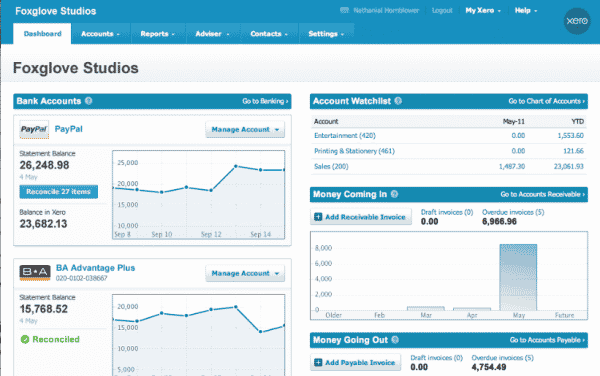
Xero has a clean, intuitive interface and is very easy to use. You can easily set up and manage projects by creating tasks and attaching expenses to them. The software also provides a dashboard to see all of your account data in one place.

Pros

  • All plans support unlimited users
  • Reasonable pricing
  • Automatic bank feeds configuration
  • Rich in integrations

Cons

  • The time tracking feature is only available for the premium plan
  • No automatic recurring payments
  • The initial setup can be confusing for those unfamiliar with bookkeeping.
  • No live phone support

Price

Xero’s pricing plans are separated into three categories: Starter, Standard, and Premium. They offer a payroll system depending on the plan you decide. Its Premium Plan pricing changes depending on the size of your team. Below is a more detailed look into its prices, as well as the pricing for the Premium 5 plan:

  • Starter – Payroll for one person, send quotes and 20 invoices, and reconcile bank transactions for only 27 AUD a month.
  • Standard – Payroll for two people, send quotes and invoices, and reconcile bank transactions for only 54 AUD a month.
  • Premium 5 – Payroll for up to 5 people, send quotes and invoices, and reconcile bank transactions for only 70 AUD a month.

2. QuickBooks Online – Best Invoicing, Payroll, and Estimations

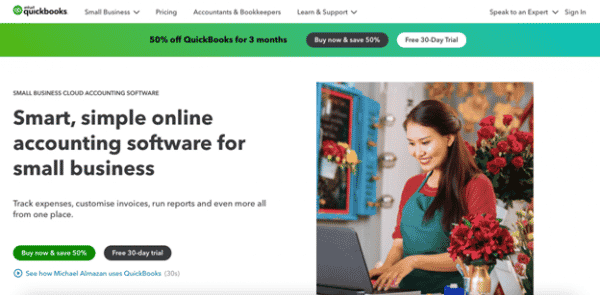
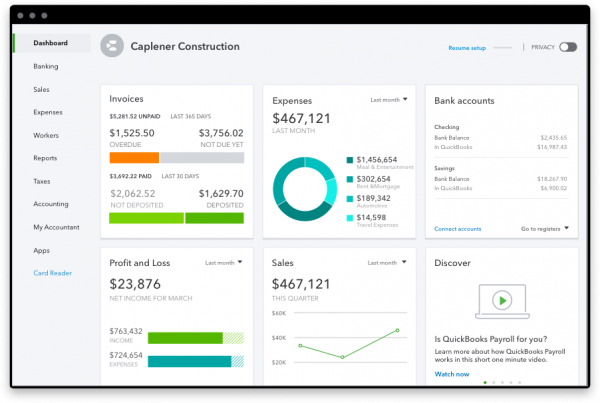
An accounting software most used by small companies to manage their income and spending and keep track of their finances. Billing customers, paying bills, generating reports, and preparing tax returns are all possible with Quickbooks. QuickBooks has various options that anybody, from a freelancer to a small business, may utilize.

Small company owners often use QuickBooks to handle invoices, pay bills, and monitor cash flow. They also use it to produce quarterly and yearly company taxes and create month- and year-end financial reports. Some company owners utilize an in-house or outsourced bookkeeper, while others prefer to handle QuickBooks themselves.

What is it best for?

This program is tailored to small enterprises that want a simple method to manage their money. It includes tools like invoicing, payroll, and estimations to help you save time while paying bills and filing taxes for your company.

Pros

  • User interface surpasses expectations
  • Automated payroll reminders
  • Thorough record-keeping and comprehensive reporting

Cons

  • Monthly plans are expensive compared to alternatives
  • Maintaining and adding features is expensive
  • Inability to revert to a previous versions

Price

QuickBooks Online’s pricing plans go three ways with a 30-day free trial on all of them: Simple Start, Essentials, and Plus. The pricing ranges from 8 USD up to 17 USD per month. Here’s a more in-depth look at its pricing:

  • Simple Start – Send custom quotes and invoices, track your VAT, and your accountant for only 8 USD per month for one user.
  • Essentials – Send custom quotes and invoices, track your VAT, insights and report, multi-currency, and for three users plus your accountant for only 12.50 USD per month
  • Plus – Send custom quotes and invoices, track your VAT, track inventory, manage budgets, and for five users plus your accountant for only 17 USD per month.

3. FreshBooks – Most Intuitive Interface

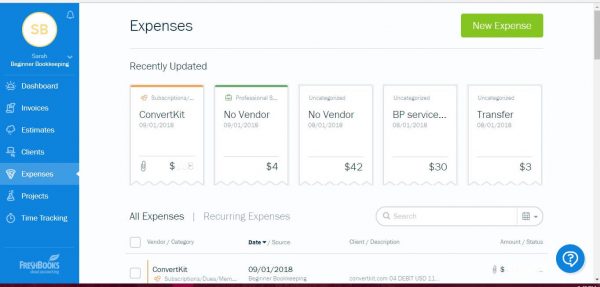
FreshBooks is a cloud-based accounting program for freelancers and small company owners. An online invoicing and accounting software tool that offers an easy-to-use interface. It helps you, monitor, manage, and send invoices and generate reports with ease. The system also integrates with many of your favorite apps and services, including Google Drive, Slack, FreshBooks’ online invoice-tracking app, etc. 

What is it best for?

FreshBooks is well suited for smaller businesses and companies with one primary owner and operator. It’s a simple, intuitive interface that allows you to get up and sprint with your accounting software.

FreshBooks is great if you’re looking for a bookkeeping app that can help you manage invoices and payments without being overwhelming or if you want something that will integrate seamlessly with other apps in your business ecosystem.

Pros

  • FreshBooks includes an easy-to-use dashboard and interface.
  • For freelancers and small enterprises, it’s simple to utilize.
  • Positive impact on its payroll systems

Cons

  • Quarterly task estimates are not available on FreshBooks
  • It does not work well for large businesses
  • The lowest-tier package does not provide bank reconciliation or access to an accountant.
  • Not compatible with internet explorer.

Price

We looked at FreshBooks’ pricing plans and decided that they were pretty fresh. FreshBooks offers three paid plans with one customizable plan, which is pretty standard for this software. We thought the costs were extremely fair, particularly compared to some of the other alternatives available today. Each plan is described in-depth below:

  • Lite – Access to 5 billable clients, send unlimited invoices for the five clients, track unlimited expenses, and access anywhere on iOS and Android for only $4.50 per month.
  • Plus – Access to 50 billable clients, send unlimited invoices for the 50 clients, automatically track expenses, and accountant invitation for only $7.50 per month.
  • Premium – Access to unlimited billable clients, send unlimited invoices to all clients, track project profitability, and accountant invitation for only $15.00 per month.
  • Customizable – Access to unlimited billable clients, specialized features, remove FreshBooks branding from client emails, start with 2 team member accounts, and accountant invitation for customizable pricing.

4.Realtyzam – Easiest to Set Up

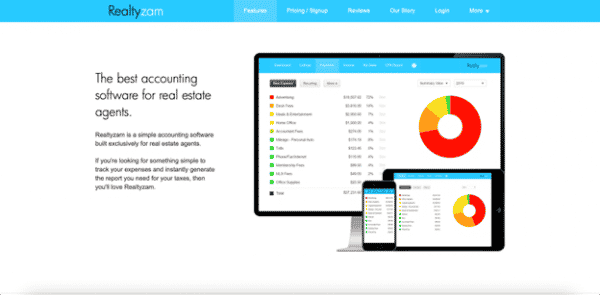
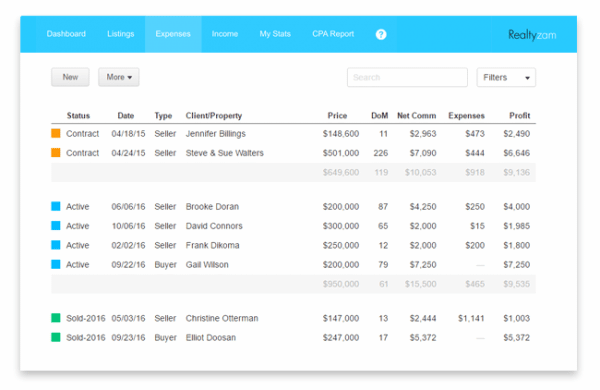
Realityzam is cloud-based accounting software for real estate agents and property managers that offers an easy-to-use interface. It’s easy and simple to use. For example, it may connect your bank account and credit cards to monitor and categorize your income and spend it automatically. Using its easy reporting capabilities, you can monitor your average commission, selling price, and other information.

What is it best for?

RealtyZam is a good choice if you’re looking for real estate accounting software that’s easy to use and affordable. You can set up your own business with just a few clicks and then start using the software.

RealityZam is one of the most popular accounting software programs on the market, and it’s easy to see why: it has automatic Transaction Sorting. This means that when you enter a transaction into RealityZam, it automatically places it in the right month and year, saving you from having to do that yourself every time.

Pros

  • Includes a client relationship management (CRM) module for increased productivity
  • User-friendly
  • Provides new agents with a free trial and a unique offer.

Cons

  • Essential accounting features like invoicing and bill management are missing.
  • Realtyzam is not designed for teams and brokers
  • It does not have mileage tracking

Price

Realtyzam has a simple pricing plan that will make you wonder why other companies even bother with complex plans. A quick overview of its pricing plan can be seen below:

  • Free forever – Realtyzam did not disclose the features available to avail this plan.
  • Monthly- Realtyzam did not disclose the features available for availing of this plan, but its monthly payment is $12 per month, billed anytime.
  • Annually – Realtyzam did not disclose the features available for choosing this plan, but its annual payment is $9.50 per month billed annually.

5.Wave – Completely Free to Use

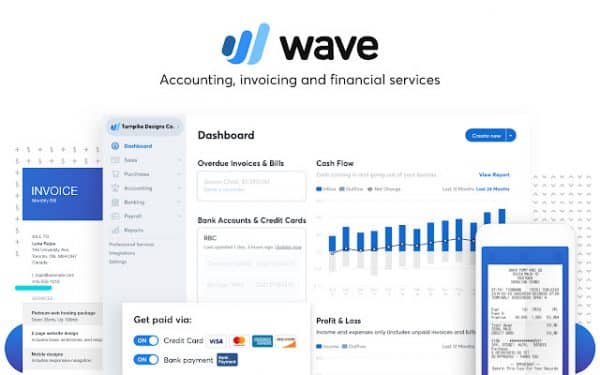
If you’re searching for free accounting software, Wave Accounting is a great option. This financial management software is simple to use and understand, even for people without previous accounting knowledge. In addition, through internal integrations, you can handle bookkeeping, accounting, and invoicing all in one spot.

What is it best for?

Wave is great for small-business owners who don’t have the time or resources to invest in high-end accounting software. It does all you want of it, and it does it well. It offers you a full, end-to-end company management solution.

Wave features a straightforward user interface that makes it easy for small company owners. It also enables you to manage all of your papers and client interactions in one location, and it is available from any device with an internet connection.

Pros

  • Invoicing is unlimited, with customized layouts and payment options.
  • Has double-entry bookkeeping
  • Adding a logo to your invoice is free.

Cons

  • Updates change certain functions’ forms.
  • There are no further plans to improve functionality.
  • Lots of negative customer reviews 
  • The invoice numbers on recurring invoices are not sequential.

Price

The wave pricing plan is 100% free, and it includes everything you need to get started.

6. Zoho Books – Most Integration Options

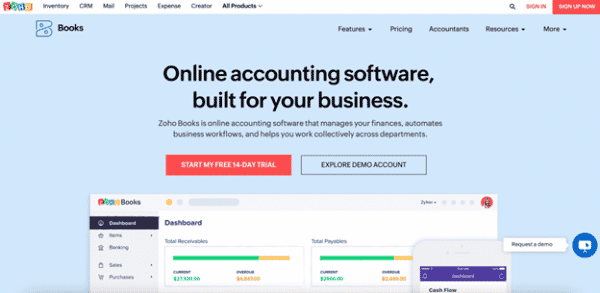
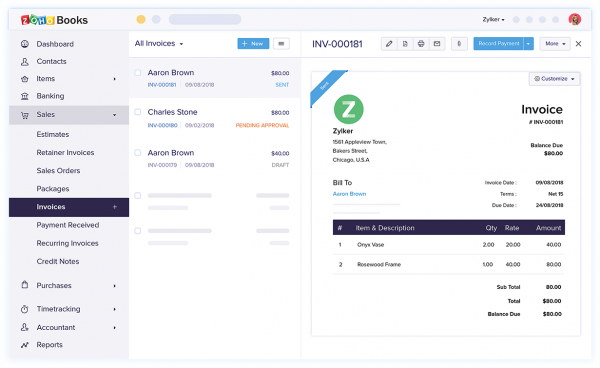
Zoho Books is a popular element of the company’s vast productivity suite, which is meant to assist in expanding businesses’ accounting and financial processes. It is frequently defined as an easy-to-use system that requires no training and a smart and professional invoicing solution that allows businesses to collect and process online payments quickly and easily. In addition, contact management is possible with Zoho Books.

What is it best for?

Zoho Books is the finest accounting software for organizing your transactions and managing your accounting responsibilities.

Both small businesses and large enterprises can use this software. It supports multiple currencies and languages. You can also export data into Excel or Google Sheets files to use in other programs as well.

Pros

  • Robust features
  • There are various plans to choose from
  • Data is easily accessed and shared with other users and experts.
  • Price plans are affordable for small and mid-sized businesses.

Cons

  • Limited to inside California and Texas only.
  • Zoho Books does not offer payroll services to its users.
  • Software is difficult for new users, and it’s not easy to learn how to handle accounting and invoicing.
  • Automatic matching is not efficient
  • Comments are not allowed in the weekly logs

Price

Zoho Books is an excellent option if you’re looking for a good-quality, low-cost solution. The four plans range from $0/month to $36/month, with the free plan being the most limited one. But even the free version has some cool features! Below is a quick overview of its pricing:

  • Free – Access to 1 user and one accountant, up to 1,000 invoices per annum, the ability to add multiple bank accounts and credit cards, three payment gateways, and email support for $0 a month.
  • Standard – Access to everything in the Free plan plus the ability to invite 3users, manage up to 5,000 invoices, predefined user roles, bulk updates, transaction locking, 11 payment gateways, and email, chat, and voice support $12 per organization every month. 
  • Professional – Access to everything in the Standard plan plus the ability to invite five users, sales approval, multi-currency handling, timesheet approval, and up to 10 workflow rules for $24 per organization every month.
  • Premium – Access to everything in the Professional plan plus the ability to invite ten users, three branches, multi-transaction number series, budgeting, validation rules, and up to 200 workflow rules for $36 per organization every month.

7. Lone Wolf Back Office – Best for Real Estate Investors

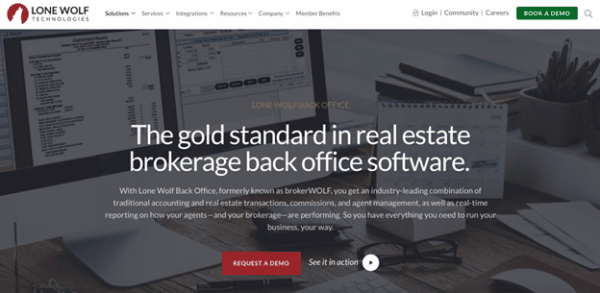
Lone Wolf Back Office (formerly BrokerWOLF) is the accounting software that real estate investors have waited for. It’s the only solution program on the market that will make your life easier—and it’s all contained inside one package.

With Lone Wolf, you won’t have to worry about losing any of your data. Instead, it puts everything in one place so you can see what you need when you need it. It also helps streamline your business processes and keep your finances organized so that you can focus on growing your business.

What is it best for?

Lone Wolf Real Estate Accounting Software is the perfect choice for any real estate agent who wants to manage their business independently. Real estate agents designed this software for real estate agents, so it’s easy to use and navigate.

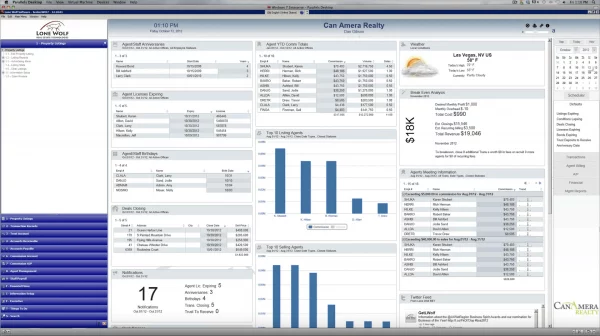
Lone Wolf is best for managing your listings and MLS integration, accounting and financial records, automated commission calculation, and agent management. The program is cloud-based, and its team of specialists is available to help you with any queries you have regarding your company.

Pros

  • The accounting and transaction management system for a brokerage is well integrated.
  • Excellent customer support
  • Feature-rich

Cons

  • Difficult to navigate through, even for tech-savvy people
  • Data entry does not work with other companies
  • The interface is not up to date
  • The searching algorithm isn’t as strong as other competitors

Price

Lone Wold Back Office’s pricing is not disclosed on its website; you have to contact customer service to retrieve customizable pricing.

8. CORE BackOffice – Manage Agent Onboarding + Financials in One App

CORE BackOffice, formerly Brokersumo, is a low-cost brokerage backend containing transaction data, commission tracking, agent onboarding, etc. They provide brokerage accounting, ACH, onboarding, reporting functions, and the ability to charge agents via the system.

What is it best for?

Core BackOffice is the best solution for brokers because it allows you to manage agent onboarding and billing, commission tracking and disbursements, reporting and accounting—all in one platform.

You can easily create your commission plans, set up recurring billing schedules, and keep track of commissions and disbursements through an intuitive dashboard.

Pros

  • Processing payments is quick
  • Lots of positive reviews from satisfied clients
  • The software is easy to navigate

Cons

  • Customer service is not responsive to queries 
  • Cost procedures are not clear

Pricing

Core BackOffice does not disclose its pricing on its website; you have to contact Core BackOffice to get your customized price plan.

9. Realty APX – Integrates with CRM

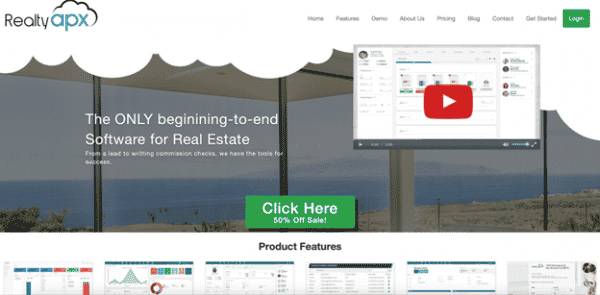
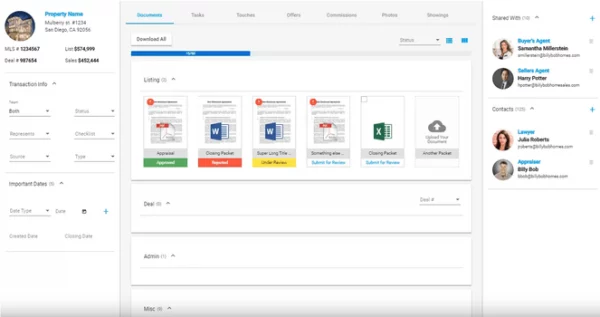
RealtyAPX is a full web-based Real Estate front office, back office, and mobile office management software for Brokers and Agents. In addition, it offers Windows-specific end-to-end solutions. Website management, contract management, CRM, commission management, and electronic signature are all included in this online real estate system.

What is it best for?

Realty APX is the ideal choice for real estate agents and brokers who have been trying to find a real-time tool that will help them manage their businesses.

This software was designed with real estate professionals in mind; its countless features make it easy for agents to manage their listings, do their accounting, and keep up with their clients’ financials. It’s best for agents who want to do everything within one system.

Realty APX also offers automation so that every single transaction can be tracked. 

Pros

  • The platform itself is simple and intuitive
  • Customer service is top-notch
  • Lots of positive customer reviews

Cons

  • Expensive pricing plans
  • The site sometimes has long-term errors when updates occur

Price

Realty APX has a lot of pricing plans to choose from, but we’re going to make it easy for you:

  • Small – Office with up to 10 users, transactions management, office accounting, and documents management for $99.99 monthly billed annually.
  • Medium – Office with up to 25 users, transactions management, office accounting, documents management, and full access for $199.99 monthly billed annually.
  • Large – Office with up to 50 users, transactions management, office accounting, documents management, and managing multiple offices for $299.99 monthly billed annually.

10. Emphasys – Best for Brokerages that are Scaling

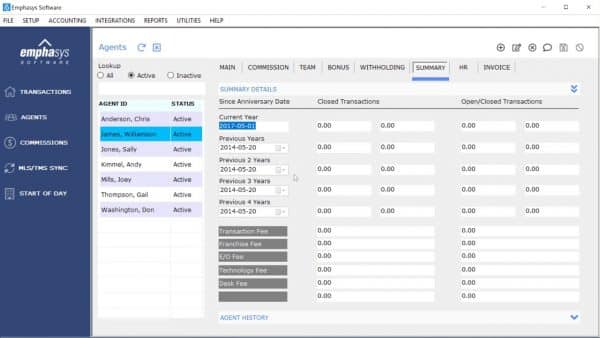
Emphasys is cloud-based accounting software that makes it easy for real estate agents to manage their clients and sales. You can put the power of reporting and monitoring at your fingertips with Emphasys to acquire essential insight into your company and boost profits. The software offers many tools and features to help you manage your real estate business. 

What is it best for?

It’s best for any real estate brokerage that wants to manage its client’s revenue and expenses. It’s a great tool for bringing in new business and managing the commission process and showing management.

It has great tools for automating your business, consolidating data, and analyzing trends. In addition, the intuitive dashboard gives you a clear view of your finances and allows you to drill down into specific areas of your business.

Pros

  • The software is robust.
  • This is a wonderful resource for real estate brokerages seeking an accounting solution.
  • Responsive customer service
  • Has MLS and Quickbooks integrations

Cons

  • It takes some detective effort to figure out error messages.
  • Lack of online reviews and users

Price

Emphasys does not disclose its pricing plans on its website; you have to contact its team to determine your specific pricing. 

What Is Real Estate Accounting Software?

Real estate brokerages use real estate accounting software to help them manage their business. It helps them collect and analyze data, manage money, and make essential reports about the company. It may also be used for tax preparation or to keep track of daily transactions so that management can advise customers about their investments or pay taxes on revenues.

How Does Real Estate Accounting Software Work?

The software is a cloud-based solution that integrates with your existing business platforms and software. It allows you to collect data from multiple sources, and then it analyzes that data so you can see trends, who is buying what, and where your money should be going. It tracks all transactions for you to don’t have to remember them. 

Some Real Estate Accounting Software provides automatic revenue control or order management to automatically transfer money between offices based on requests from buyers or sellers. The software may also help keep you organized by tracking transactions, expenses, and reports.

What Are the Advantages of Using Real Estate Accounting Software?

The software provides you with a real-time look at your business. It can also help you find trends about how much you are spending and how much money you are making. It will help you to generate well-thought-out reports and plans, which can help you make changes to your business model or cut costs if they’re not necessary. 

You Can Access Your Data Anywhere, Anytime

Your account managers and brokers can log in to their accounts and access real estate accounting software from any device. This means that you don’t have to worry about them forgetting important numbers or events, or that they will lose important data. You can also get reports at any time, which makes it easy for you to access data at a glance. 

Secures Your Transactions

Real estate accounting software encourages security and privacy by encrypting all data and maintaining it in a secure location. You can also manage how your account information is shared with your staff so that they don’t see sensitive information. 

Conclusion: What Is the Best Real Estate Accounting Software?

While many real estate accounting solutions use advanced features and functions, the nature of these solutions is similar. Some will allow you to utilize all kinds of functions, while others are built around a specific function. Ultimately, your choice will depend on what you want to do with the software.