TUP is Transistor Universal PNP, TUN is Transistor Universal NPN, DUG is Diode Universal Germanium and DUS Diode Universal Silicon , are standard components that most retailers have in stock and have minimum specification that use as general purpose diode and low frequencies transistor with different type numbers and have similar specification.
The circuit is use for test Quartz Crystal from 1 MHz to 50 MHz, if the crystal X1 good enough, sinewave will appears on Emiter T1 BF494 , and rectified by D2 IN4148 , drive D1 IN4148 and will charge Capacitor C4 until enough voltage to turn on Transistor BC547 and make the LED 1 on. This circuit using 9 V battery for enough consumption , below is PCB you can design . ( Source : Elektor Summer circuit)
This is circuit for Fun, receive spark transmissions signal from switch on off light , motors, high voltage lightning , electric motors can detected by this receiver on short wave band.
If you have old AM radio , you can use this circuit to change to Short Wave Radio, and tune the Short Wave frequency and start listening Short Wave around the world. The AM SW short wave radio can works from 1.6 MHz until 10 MHz by C1 with various values. from 150 pF until 10 pF , or you can use Trimmer Capacitor from 0-200 pF. For Crystals X1 can use 34.545 MHZ overtone crystal.
As datasheet NE602 describe , the features of this IC :
* Low current consumption : typical 2.4 mA
* Excellent noise figure : < 4.7 dB typical at 45 MHz
* High Operating frequency
* Excellent gain : intercept and sensitivity
* Low external parts count ; suitable for crystal / ceramics filter
NE602 Pin Out :
Test Configuration for NE602 , look at Crystal on Pin 6.
Applications :
* Portable Radio
* Cellular Radio
Example for Cellular Radio Application :
* VHF Transceivers
* RF Data Links
* HF / VHF Frequency conversion
* Instrumentation frequency conversion
* Broadband LANs
Voice IC recording system memory , ISD1416 from Winbond can use for many application such Answering Machine Phone, Talking Clocks also for private application such as in Public Services to tell People How To use Toilet, private toilet by record instruction for 2 minutes.
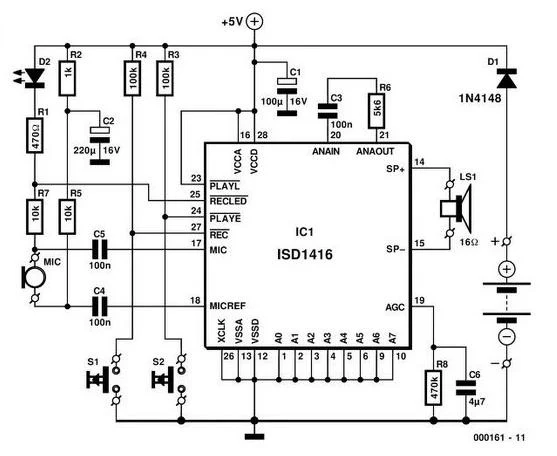

The Features of ISD1416 :
* Easy to use single chip voice record/playback solution
* High quality, natural voice/audio reproduction
* Push button interface
- Playback can be edge or level activated
* Single chip durations of 16 and 20 seconds
* Automatic power down mode
- Enters standby mode immediately following a record or playback cycle
- Standby current 0.5 uA (typical)
* Zero power message storage
- Eliminates battery backup circuits
* Fully addressable to handle multiple messages
* 100 year message retention (typical)
* 100,000 record cycles (typical)
* On-chip clock source
* No programmer or development system needed
* Single +5 volt power supply
* Available in die form, DIP, and SOIC packaging
* Industriall temperature (-40 Celcius degree to +85 Celcius degree) versions available
ISD 1400 Series Pinouts
Application Note example from datasheet ISD1416
For datasheet ISD1416 Please click here.


